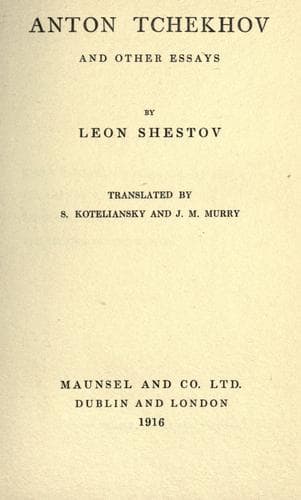
Chekhov, Anton Pavlovich, 1860-1904; Dostoyevsky, Fyodor, 1821-1881; Philosophy; Russian literature -- History and criticism
To-day they defend scientific knowledge; to-morrow they will attack it.
Indeed, it so happens that the very belief in the causal law begets a
great disquiet and turmoil in the soul, which finally produces all the
horrors of chaos and madness. The certainty that the existing order
is immutable is for certain minds synonymous with the certainty that
life is nonsensical and absurd. Probably the disciples of Christ had
that feeling when the last words of their crucified Master reached them
from the cross: 'My God, my God, why hast Thou forsaken me?' And the
modern theorists may explain triumphantly that when the law became the
instrument of chaos and madness, it was _ipso facto_ abolished. 'Christ
has risen,' say the disciples of Christ.
I have said that the theorists may triumph; but I must confess that I
have not found in any of them an open glorification of such an obvious
proof of the truth of their teaching. Of the resurrection of Christ
they say not a word--on the contrary, they make every effort to avoid
it and pass it by in silence. And this circumstance compels us to pause
and think. A dilemma arises: if you grant that the law of causation
suffers no exception, then your soul will be eternally haunted by the
last words of the crucified Christ; if you do not, then you will have
no science. Some assert that it is impossible to live without science,
without knowledge, that such a life is horror and madness; others
cannot be reconciled to the thought that the most perfect of men died
the death of a murderer. What shall we do? Without which thing is it
impossible for man to live? Without scientific knowledge, or without
the conviction that truth and spiritual perfection are in the last
resort the victors of this world? And how will the theory of knowledge
stand with regard to questions such as these?
Will it still continue its exercises in apologetics or will it at last
understand that this is not its real problem, and that if it would
preserve the right to be called philosophy, it will have not to justify
and exalt the existing science, but to examine and direct some science
of its own. It means above all to put the question: Is scientific
knowledge really perfect, or is it perhaps imperfect, and should it
therefore yield its present honourable place to another science?
Evidently this is the most important question for the theory of
knowledge, yet this question it never puts. It wants to exalt existing
science. It has been, is now, and probably will long continue to be,
apologetics.
_Truth and Utility_
Public-domain text, read in full here on John Shaqi.
Reviews
Reviews
No reviews yet
Be the first to share your thoughts on this work.
Elsewhere in the archive
Join the Discussion
Join the discussion
Sign in to leave a comment or review.
Sign InorCreate an account