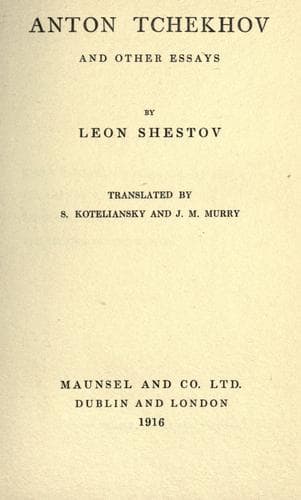
Chekhov, Anton Pavlovich, 1860-1904; Dostoyevsky, Fyodor, 1821-1881; Philosophy; Russian literature -- History and criticism
it will not bear continuation, that it exists only in and for itself,
that it is self-sufficient. If some one said this, how would he be
answered? People could not dispute with him--try to dispute with a man
who wants neither to dispute nor to demonstrate.
The only answer is an appeal to the popular verdict, to lynch law.
People are so weak and naïve that they will at all costs see a teacher
(in the usual sense of the word) in every philosopher. In other words,
they really want to throw upon him the responsibility for their
actions, their present, their future, and their whole fate. Socrates
was not executed for teaching, but because the Athenians thought he
was dangerous to Athens. And in all ages men have approached truth
with this criterion, as though they knew beforehand that truth must
be of use and able to protect them. One of the greatest teachings,
Christianity, was also persecuted because it seemed dangerous to the
self-appointed guardians, or, if you will, because it was really very
dangerous to Roman ideals. Of course, neither Socrates' death nor the
deaths of thousands of the early Christians saved the ancient culture
and polity from decay: but no one has learned anything from the lesson.
People think that these were all accidental mistakes, against which no
one was secure in ancient times, but which will never again recur; and
therefore they continue to make 'deductions' as they used from every
truth, and to judge the truth by the deductions they have made. And
they have their reward. Although there have been on earth many wise men
who knew much that is infinitely more valuable than all the treasures
for which men are ready even to sacrifice their lives, still wisdom is
to us a book with seven seals, a hidden hoard upon which we cannot lay
our hands. Many--the vast majority--are even seriously convinced that
philosophy is a most tedious and painful occupation to which are doomed
some miserable wretches who enjoy the odious privilege of being called
philosophers. I believe that even professors of philosophy, the more
clever of them, not seldom share this opinion and suppose that therein
lies the ultimate secret of their science, revealed to the initiate
alone. Fortunately, the position is otherwise. It may be that mankind
is destined never to change in this respect, and a thousand years hence
men will care much more about 'deductions,' theoretical and practical,
from the truth than about truth itself; but real philosophers, men who
know what they want and at what they aim, will hardly be embarrassed
by this. They will utter their truths as before, without in the least
considering what conclusions will be drawn from them by the lovers of
logic.
_Truths, Proven and Unproven_
Public-domain text, read in full here on John Shaqi.
Reviews
Reviews
No reviews yet
Be the first to share your thoughts on this work.
Elsewhere in the archive
Join the Discussion
Join the discussion
Sign in to leave a comment or review.
Sign InorCreate an account