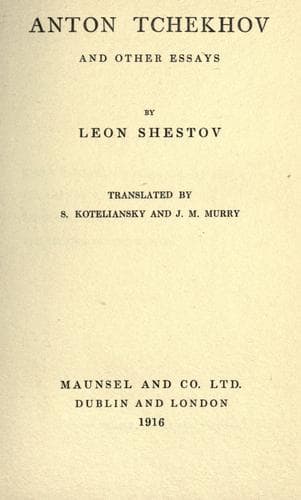
Chekhov, Anton Pavlovich, 1860-1904; Dostoyevsky, Fyodor, 1821-1881; Philosophy; Russian literature -- History and criticism
Whence did we get the habit of requiring proofs of each idea that
is expressed? If we put aside the consideration, as having no real
meaning in the present case, that men do often purposely deceive their
neighbours for gain or other interests, then strictly speaking the
necessity for proof is entirely removed. It is true that we can still
deceive ourselves and fall into involuntary error. Sometimes we take
a vision for a reality, and we wish to guard against that offensive
mistake. But as soon as the possibility of _bona fide_ error is
removed, then we may relate simply without arguments, judgments, or
references. If you please, believe; if you don't, don't. And there is
one province, the very province which has always attracted to itself
the most remarkable representatives of the human race, where proofs
in the general acceptation are even quite impossible. We have been
hitherto taught that that which cannot be proved, should not be spoken
about. Still worse, we have so arranged our language that, strictly
speaking, everything we say is expressed in the form of a judgment,
that is, in a form which presupposes not merely the possibility but
the necessity of proofs. Perhaps this is the reason why metaphysics
has been the object of incessant attack. Metaphysics evidently was not
only unable to find a form of expression for her truths which would
free her from the obligation of proof; she did not even want to. She
considered herself the science _par excellence,_ and therefore supposed
that she had more largely and more strictly to prove the judgments
which she took under her wing. She thought that if she were to neglect
the duty of demonstration she would lose all her rights. And that, I
imagine, was her fatal mistake. The correspondence of rights and duties
is perhaps a cardinal truth (or a cardinal fiction) of the doctrine
of law, but it has been introduced into the sphere of philosophy by a
misunderstanding. Here, rather, the contrary principle is enthroned:
rights are in inverse proportion to duties. And only there where
all duties have ceased is the greatest and most sovereign right
acquired--the right of communion with ultimate truths. Here we must not
for one moment forget that ultimate truths have nothing in common with
middle truths, the logical construction of which we have so diligently
studied for the last two thousand years. The fundamental difference is
that the ultimate truths are absolutely unintelligible. Unintelligible,
I repeat, but not inaccessible. It is true that middle truths also are,
strictly speaking, unintelligible. Who will assert that he understands
light, heat, pain, pride, joy, degradation?
Public-domain text, read in full here on John Shaqi.
Reviews
Reviews
No reviews yet
Be the first to share your thoughts on this work.
Elsewhere in the archive
Join the Discussion
Join the discussion
Sign in to leave a comment or review.
Sign InorCreate an account