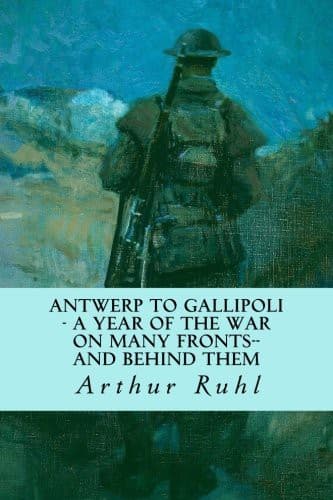
Antwerp to Gallipoli: A Year of the War on Many Fronts—and Behind ThemRuhl, Arthur
History
Antwerp to Gallipoli: A Year of the War on Many Fronts—and Behind Them
Ruhl, Arthur
World War, 1914-1918 -- Personal narratives
By this negative policy--the pressure, that is to say, of not going to
war--Bulgaria had induced Turkey, by the time I came through Sofia again
three months later, to turn over enough territory on the east so that
the Bulgars could own the railroad down to Dedeagatch and reach the
Aegean without being obliged to go into Turkey and out again. It even
seemed that Bulgaria might be able to keep her neutrality to the end.
Her compromise with Turkey was not so odd as it seemed to many at first.
She had fought the Turks, to be sure, but now got what she wanted, and
when you come to think of it, it might well be more comfortable from the
Bulgars' point of view to have the invalid Ottomans in Constantinople
than the healthy and hungry Russians.
Both these small states, in their present hopes, fears, and, dangers,
are an instructive spectacle to those who fancy that in the crowded
arena of Europe a little nation can always do as it wants to, or that
its neutrality is always the simple open-and-shut matter it looked to
be, for instance, in the first weeks of August, 1914. We are likely, at
home, to look on all this cold-blooded weighing of the chances of war
with little patience, to think of all these "aspirations" as merely
somebody else's land. Fear or envy of our neighbors, international
hatred, is almost unknown with us. All that was left behind, three
thousand miles away, and the green water in between permits us to
indulge in the rare luxury of altruism. Yet these hatreds, these fears,
and ambitions, inherited and carefully nourished, are just as real--
particularly in little states like these--as the fact, odd and
apparently unreasonable as it may be, that in a bit of country, which
might be included in one of our larger States, one lot of people should
speak French and think like Latins, and another speak Slavic and think
another way, and that neither wants to be absorbed by the other any more
than we want to be compelled to speak Spanish or be absorbed by the
Mexicans.
The "aspirations" of both these little countries have realities behind
them. It is a fact that one gets a whiff of French clarity and verve in
Rumania, though it comes from a small minority educated in France, and
the Rumanian people may be no more "Latin" than we are. And it is an
interesting notion--though perhaps only a notion--that Rumania should be
the outpost or rear-guard of Latinism in this part of the world; a bit
of the restless West on the edge of the Orient.
For virility and earnestness like that of the Bulgars there is a place,
not only in the Balkans, but everywhere. The qualities they have shown
in their short life as an independent nation are those which deserve to
be encouraged and preserved. And if it were true that this war were
being fought to establish the right of little nations to live, one of
the tasks it ought to accomplish, it seemed then, was to give the
Bulgars back at least part of what was taken from them.
Chapter X
Public-domain text, read in full here on John Shaqi.
Reviews
Reviews
No reviews yet
Be the first to share your thoughts on this work.
Elsewhere in the archive
Join the Discussion
Join the discussion
Sign in to leave a comment or review.
Sign InorCreate an account