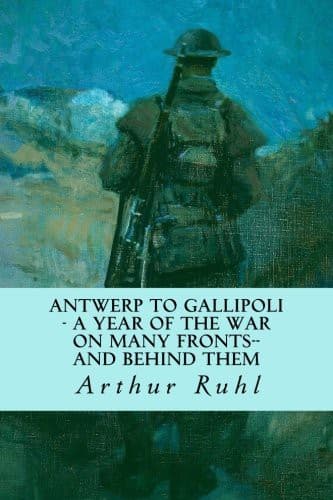
Antwerp to Gallipoli: A Year of the War on Many Fronts—and Behind ThemRuhl, Arthur
History
Antwerp to Gallipoli: A Year of the War on Many Fronts—and Behind Them
Ruhl, Arthur
World War, 1914-1918 -- Personal narratives
An observation-balloon looked up over the western horizon, there was a
sudden thunder, and all at once the sky above Gallipoli rained screaming
shells and death. You can imagine--at any rate remembering Antwerp, I
could very well imagine--how that hurricane of fire, sweeping in without
warning, from people knew not where, must have seemed like the end of
the world. You can imagine the people--old men with turbans undone,
veiled women, crying babies--tumbling out of the little bird-cage houses
and down the narrow streets. Off went the minaret, as you would knock
off an icicle, from the mosque on the hill. The mosque by the
water-front went down in a cloud of dust, and up from the dust, from a
petrol shell, shot a geyser of fire. Stones came rumbling down from the
old square tower, which had stood since the days of Bayazid; the faded
gray houses squashed like eggs. It was all over in an hour--some say
even twenty, minutes--but that was long enough to empty Gallipoli, to
kill some sixty or seventy people, and drive the rest into the caves
under the cliffs by the water, or across the Marmora to Lapsaki.
Now, while the bombardment of Gallipoli may not appear from a merely
human point of view, a particularly sporting performance, yet, as most
of those killed were soldiers, as Gallipoli had been a staff
head-quarters not long before and always has been a natural base for the
defense of the Dardanelles, the attack was doubtless justified by the
rules of war. It happens, however, that people who live in defenseless,
bombarded towns are never interested in the rules of war. So a new and
particularly disturbing rumor went flying through the crowded streets of
Constantinople.
It is a city of rumors, this beautiful, bewildering Bagdad of the West,
where all the races of the world jostle each other in the narrow
streets, and you never know how the man who brushes past you lives--let
alone feels and thinks. The Constantinople trolley-cars are divided by
a curtain, on one side of which sit the men, on the other the veiled
women. When there are several women the conductor slides the curtain
along, so that half the car is a harem; when there are none he slides it
back, and there is no harem at all.
And life is like that. You are at once in a modern commercial city and
an ancient Mohammedan capital, and never know when the one will fade out
like a picture on a screen and leave you in the Orient, facing its
mystery, its fatalism, its vengeance that comes in a night.
Public-domain text, read in full here on John Shaqi.
Reviews
Reviews
No reviews yet
Be the first to share your thoughts on this work.
Elsewhere in the archive
Join the Discussion
Join the discussion
Sign in to leave a comment or review.
Sign InorCreate an account