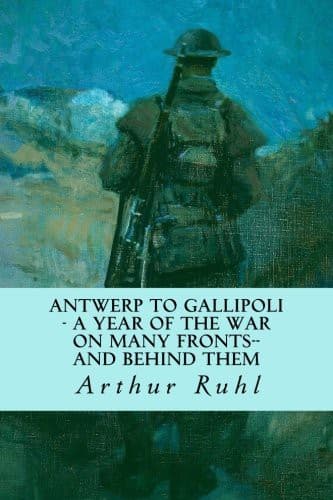
Antwerp to Gallipoli: A Year of the War on Many Fronts—and Behind ThemRuhl, Arthur
History
Antwerp to Gallipoli: A Year of the War on Many Fronts—and Behind Them
Ruhl, Arthur
World War, 1914-1918 -- Personal narratives
We passed even these signs of war and came into pines and open meadows--
we might have been driving to somebody's trout preserve. The wagon
stopped near a sign tacked to a tree, and we walked down a winding path
into a thicket of pines. There were tents set in the bank and covered
with boughs, and out of one came a tall, square-jawed German officer,
buttoning his coat. He waved aside our passports with the air of one
not concerned with such details, asked if we spoke German--or perhaps we
would prefer French?--and, motioning down the path to a sort of
summer-house with a table and chairs, told an orderly to bring tea.
This was the headquarters of the Fifth Army, and this the commander-in-
chief. A bird-man might have flown over the neighborhood a dozen times
without guessing that they were there. We were hidden in the pines, and
only an occasional far-off Br-r-rum-m! from the cannons in the south
broke the stillness. Some one had brought up a cask of native claret
from Chanak, and the field-marshal's staff were helping to put it into
the bank in front of the arbor. A professor of chemistry--until the war
called him back to the colors--was shovelling and showing the Turkish
soldiers how the cask should be slanted; another of the superintendents
had lived for ten years in America, and was enthusiastic over the charms
and future of Davenport, Iowa. Presently tea came, and thin little
sandwiches and cigars, and over these the commander-in-chief spoke with
complete cheerfulness of the general situation.
The English and French could not force the Dardanelles; no more could
they advance on land, and now that the submarines had arrived, the
fleet, which had been bothersome, would be taken care of. He spoke with
becoming sorrow of the behavior of Italy, and did not mar this charming
little fete champetre with any remarks about American shipments of arms.
The ex-banker from Davenport also spoke of the Italians, and with a
rather disconcerting vigor, considering that they were recent allies.
The young aide-de-camp whom we had seen at the wharf declared that the
Turkish soldier was the best in the world. It was a very different army
from that which had been defeated in the Balkan War, and the endurance
and tenacity of the individual soldier were beyond anything he had ever
seen. A man would see a dozen of his comrades killed alongside him by a
high-explosive shell and only shrug his shoulders and say that now, at
any rate, they were all in paradise.
One continually hears similar comments, and there can be no doubt of the
Turkish soldier's bravery, and his unusual ability to endure hardship.
No one who has wrangled with a minor Turkish official, and experienced
the impassive resistance he is able to interpose to anything he doesn't
want to do, will underestimate what this quality might become,
translated into the rugged physique and impassivity of the common
soldier.
Public-domain text, read in full here on John Shaqi.
Reviews
Reviews
No reviews yet
Be the first to share your thoughts on this work.
Elsewhere in the archive
Join the Discussion
Join the discussion
Sign in to leave a comment or review.
Sign InorCreate an account