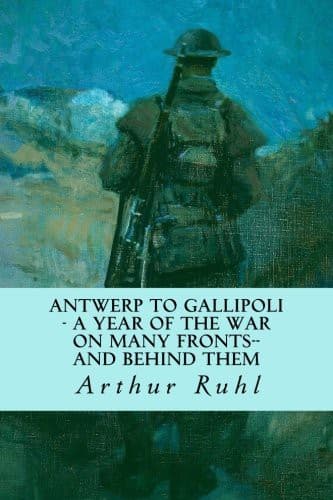
Antwerp to Gallipoli: A Year of the War on Many Fronts—and Behind ThemRuhl, Arthur
History
Antwerp to Gallipoli: A Year of the War on Many Fronts—and Behind Them
Ruhl, Arthur
World War, 1914-1918 -- Personal narratives
A hidden battery roared and--pop!--a little puff of cotton floated in
the sky under the approaching flier. Another and another--all the
nervous little batteries in the hills round about were coming to our
rescue. The bird-man, safely above them, drew on without flinching. We
had looked up at aeroplanes many times before and watched the pretty
chase of the shrapnel, and we leaned out from under the awning to keep
the thing in view. "Look," I said to Suydam; "she's coming right over
us!" And then, all at once, there was a crash, a concussion that hit the
ear like a blow, a geyser of smoke and dust and stones out on the flat
in front of us. Through the smoke I saw a horse with its pack undone and
flopping under its belly, trotting round with the wild aimlessness of
horses in the bull-ring after they have been gored. Men were running,
and, in a tangle of wagons, half a dozen oxen, on the ground, were
giving a few spasmodic kicks.
Men streaked up from the engine-room and across the wharf--after all,
the wharf would be the thing he'd try for--and I found myself out on the
flat with them just as there came another crash, but this time over by
the Barbarossa across the bay. Black smoke was pouring from the Turkish
cruiser as she got under way, and, with the shrapnel puffs chasing
hopelessly after, the flier swung to the southward and out of right.
Officers were galloping about yelling orders; over in the dust where the
bomb had struck, a man was sawing furiously away at the throats of the
oxen (there were seven of them, and there would be plenty of beef in
camp that night at any rate); there was a dead horse, two badly wounded
men and a hundred feet away a man lying on his face, hatless, just as he
had been blown there: dead, or as good as dead. It appeared that two
fliers had come from opposite directions and most of the crowd had seen
but the one, while the other dropped the bomb. It had struck just
outside the busiest part of the camp, aimed very likely at the stores
piled there. It had made a hole only five or six feet wide and two or
three feet deep, but it had blown everything in the neighborhood out
from it, as the captain had said. Holes you could put your fist in were
torn in the flanks of the oxen by flying stones and chunks of metal, and
the tires of some of the wagons, sixty or seventy feet away, had been
cut through like wax.
Public-domain text, read in full here on John Shaqi.
Reviews
Reviews
No reviews yet
Be the first to share your thoughts on this work.
Elsewhere in the archive
Join the Discussion
Join the discussion
Sign in to leave a comment or review.
Sign InorCreate an account