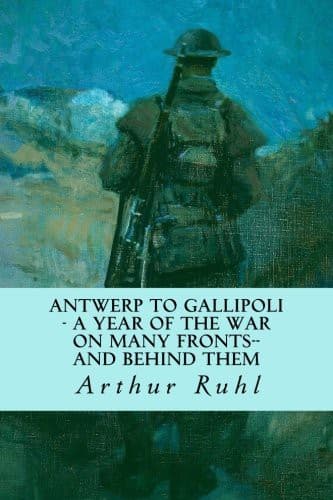
Antwerp to Gallipoli: A Year of the War on Many Fronts—and Behind ThemRuhl, Arthur
History
Antwerp to Gallipoli: A Year of the War on Many Fronts—and Behind Them
Ruhl, Arthur
World War, 1914-1918 -- Personal narratives
The things correspondents were permitted to see differed from those seen
on the other fronts less in kind than in quantity. More trips were
made, but there is and can be little place for a civilian on a "front,"
any spot in which, over a strip several miles wide, from the heavy
artillery positions of one side to the heavy artillery of the other, may
be in absolute quiet one minute and the next the centre of fire. There
is no time to bother with civilians during an offensive, and, if a
retreat is likely, no commander wishes to have country described which
may presently be in the hands of the enemy. Hidden batteries in action,
reserves moving up, wounded coming back, fliers, trenches quiet for the
moment--this is about as close to actual fighting as the outsider, under
ordinary circumstances, can expect to get on any front. The difference
in Austria-Hungary was that correspondents saw these things, and the
battle-fields and captured cities, not as mere outsiders, picked up from
a hotel and presently to be dropped there again, but as, in a sense, a
part of the army itself. They had their commandant to report to, their
"camp" and "uniform"--the gold-and-black Presse-Quartier arm band--and
when they had finished one excursion they returned to headquarters with
the reasonable certainty that in another ten days or so they would start
out again.
Chapter XIV
Cannon Fodder
At the head of each iron bed hung the nurse's chart and a few words of
"history." These histories had been taken down as the wounded came in,
after their muddy uniforms had been removed, they had been bathed, and
could sink, at last, into the blessed peace and cleanness of the
hospital bed. And through them, as through the large end of a
telescope, one looked across the hot summer and the Hungarian fields,
now dusty and yellow, to the winter fighting and freezing in the
Carpathians.
"Possibly," the doctor said, "you would like to see one of these cases."
The young fellow was scarce twenty, a strapping boy with fine teeth and
intelligent eyes. He looked quite well; you could imagine him pitching
hay or dancing the czardas, with his hands on his girl's waist and her
hands on his, as these Hungarian peasants dance, round and round, for
hours together. But he would not dance again, as both his feet had been
amputated at the ankle and it was from the stumps that the doctor was
unwrapping the bandages. The history read: While doing sentry duty on
the mountains on March 28, we were left twenty-four hours without being
relieved and during that time my feet were frozen.
The doctor spoke with professional briskness. He himself would not have
tried to save any of the foot--better amputate at once at the line of
demarcation, get a good flap of healthy tissue and make a proper stump.
"That scar tissue'll never heal--it'll always be tender and break when
he tries to use it; he has been here four months now, and you can see
how tender it is."
Public-domain text, read in full here on John Shaqi.
Reviews
Reviews
No reviews yet
Be the first to share your thoughts on this work.
Elsewhere in the archive
Join the Discussion
Join the discussion
Sign in to leave a comment or review.
Sign InorCreate an account