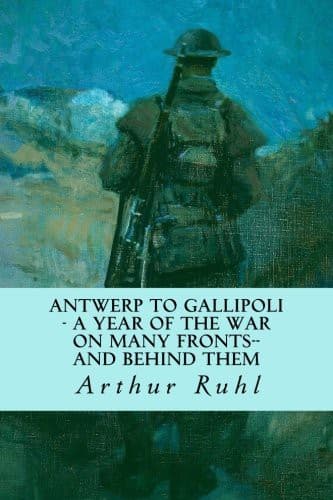
Antwerp to Gallipoli: A Year of the War on Many Fronts—and Behind ThemRuhl, Arthur
History
Antwerp to Gallipoli: A Year of the War on Many Fronts—and Behind Them
Ruhl, Arthur
World War, 1914-1918 -- Personal narratives
A young lieutenant who sat next me regaled me with his impression of
things in general. The Russians had squandered ammunition, he said, in
the early days of the war--they would fire twenty rounds or so at a
single cavalryman or anything that showed itself. They were short now,
but a supply would come evidently every now and then, for they would
blaze away for a day or so, then there would be a lull again. They were
short on officers, too, but not so much as you might think, because they
kept their officers well back of the line, generally. Their artillery
was better than the infantry, as a rule; the latter shot carelessly and
generally too high.
Both he and the officer at my left--a big, farmer-like commissary man--
spoke most amiably of the Russians. The latter told of one place where
both sides had to get water out of the same well. And there was no
trouble. "No," he said, in his deep voice, "they're not hose," using
the same word "bad" one would apply to a naughty boy. They were a
particularly chipper lot, these artillerymen, and when I told the young
lieutenant, who had been assigned to speak French to me under the notion
that I was more at home in that language, that I had stopped at Queens
Hotel instead of the St. Antoine in Antwerp, and that the Belgian army
had crossed the Scheldt, and the pontoon bridge had been blown up
directly in front of the hotel, he said that he would "certainly engage
rooms there for the next bombardment," as he waved good-by.
We were presented, while in Lemberg, to General Bom-Ermolli, and lunched
at the headquarters mess. We also met Major-General Bardolf, his chief
of staff, and chief of staff of the assassinated Crown Prince. The
latter described to us the campaign about Lemberg, and it was
interesting to hear the rasping accent he gave to a word like
"Durchbrechung," for instance, as if he were a Prussian instead of an
Austrian, and to observe the frankness with which he ascribed the
difference that had come over the spirit of the Austro-Hungarian army to
the coming of Mackensen and the Germans.
West of Lemberg the pleasant country lost its war-time air and in
Przemysl the two or three lonely Landsturm men guarding the wrecked
fortifications, twice taken and twice blown up by retreating armies, lit
candles to take us through the smashed galleries, and accepted a few
Hellers when we came out, with quite the bored air of professional
museum guides.
Public-domain text, read in full here on John Shaqi.
Reviews
Reviews
No reviews yet
Be the first to share your thoughts on this work.
Elsewhere in the archive
Join the Discussion
Join the discussion
Sign in to leave a comment or review.
Sign InorCreate an account