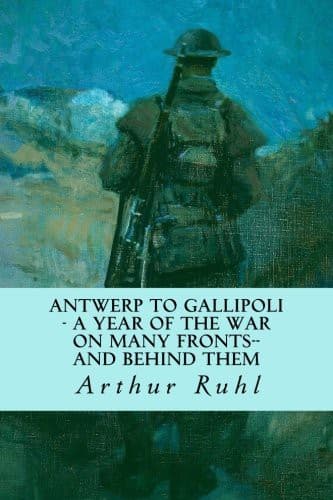
Antwerp to Gallipoli: A Year of the War on Many Fronts—and Behind ThemRuhl, Arthur
History
Antwerp to Gallipoli: A Year of the War on Many Fronts—and Behind Them
Ruhl, Arthur
World War, 1914-1918 -- Personal narratives
The country is level here--fields interspersed with dark pine forests,
planted in the European fashion, to be grown and harvested like any
other crop--parks of living telephone-posts, thick as the quills of a
porcupine. And through these pines and across the fields were the
eternal Russian trenches, carefully built, timber-lined, sometimes
roofed and sodded over, with rifle holes under the eaves. Barbed-wire
entanglements, seven rows deep sometimes, trailed in front of them,
through timber, through the long grass and flowers of marsh-land, a
wicked foggy band against the green as far as one could see. Along the
Galician front and in the Carpathians I had seen mile after mile of such
trenches, timber-work, wires, and Spanish riders left behind, good as
new, until it began to seem as if war were a peculiarly absurd game,
consisting principally in chopping down good trees and digging ditches,
and then going somewhere else.
In front of Ivangorod great preparations had been made. There was no
town here, but the great fortress, with its citadel, barracks,
machine-shops, gardens, church, and protecting forts, was almost a city
in itself. It had a garrison of twenty thousand, and its gigantic
concrete walls, covered over with earth and grass, its, moat and barbed
wire, looked formidable enough. It had no modern heavy artillery,
however, and even if it had, artillery in a fixed, known spot is
comparatively helpless against the mobile guns, screened by hills and
timber, besiegers can bring against it. Elaborate earthworks had,
therefore, been thrown up several miles to the west of the fortress, but
these became useless when the enemy, crossing the Vistula to north and
south, swung round to cut off the one way out--the railroad to
Brest-Litovsk.
The Russians might have shut themselves in and waited--not very long,
probably--until the big "thirty-point-fives" smashed the fort to pieces.
They chose to get out in time, blew up the railroad bridge across the
Bug, burned the barracks, and, with enough dynamite to give a good
imitation of an earthquake, tumbled the walls and galleries of the
fortress into melancholy heaps of rock.
It was dusk when we rolled into Ivangorod and into the thick of that
vast and complicated labor which goes on in the rear of an advancing
army--all that laborious building up which follows the retreating army's
orgy of tearing down--bridge builders, an acre or two of transport
horses, blacksmiths and iron-workers, a semi-permanent bakery, the
ovens, on wheels, like thrashing-machine engines, dropping sparks and
sending out a sweet, warm, steamy smell of corn and wheat. It never
stopped, this bakery, night or day, and the bread was piled up in a big
tent near by like cord-wood.
Public-domain text, read in full here on John Shaqi.
Reviews
Reviews
No reviews yet
Be the first to share your thoughts on this work.
Elsewhere in the archive
Join the Discussion
Join the discussion
Sign in to leave a comment or review.
Sign InorCreate an account