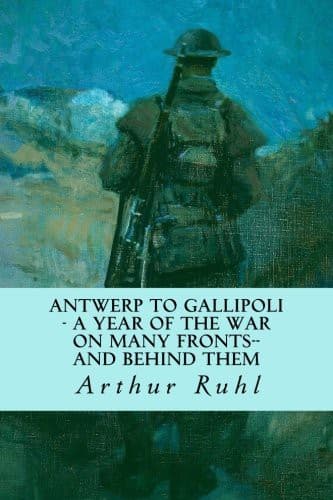
Antwerp to Gallipoli: A Year of the War on Many Fronts—and Behind ThemRuhl, Arthur
History
Antwerp to Gallipoli: A Year of the War on Many Fronts—and Behind Them
Ruhl, Arthur
World War, 1914-1918 -- Personal narratives
We went out for a walk in the frosty air before turning in. There was
scarce a soul in the streets, but at the other end of the town a handful
of young fellows passed on the other side singing. They were boys of
the 1915 class who had been called out and in a few days would be
getting ready for war. In Paris you will see young fellows just like
them, decorated with flags and feathers, driving round town in
rattle-trap wagons like picnic parties returning on a summer night at
home. Arm in arm and keeping step, these boys of Saintes were singing
as they marched:
"Il est rouge et noir et blanc, Et fendu au derriere--d."
"He's red, white, and black, And split up the back!"
They saw themselves, doubtless, marching down the streets of Berlin as
now they were marching down the streets of Saintes--and they kept
flinging back through the frosty dark:
"Il est rouge--et noir--et blanc--Et fendu--au derriere--d..."
Chapter VI
"The Great Days"
They were playing "The Categorical Imperative" that evening at the
Little Theatre in Unter den Linden. It is an old-fashioned comedy laid
in the Vienna of 1815--two love-stories, lightly and quaintly told,
across which, through the chatter of a little Viennese salon, we dimly
see Napoleon return from Elba and hear the thunder of Waterloo. A young
cub of a Saxon schoolmaster, full of simple-hearted enthusiasm and
philosophy, comes down to the Austrian capital, and, taken up by a
kindly, coquettish young countess, becomes the tutor of her cousin, a
girl as simple as he. The older woman with her knowing charm, the
younger with her freshness, present a dualism more bewildering than any
he has ever read about in his philosophy books, and part of the fun
consists in seeing him fall in love with the younger in terms of pure
reason, and finally, when the motherly young countess has quietly got
him a professorship at Konigsberg, present to his delighted Elise his
"categorical imperative."
You can imagine that thoroughly German mixture of sentiment and
philosophy, the quaint references to a Prussia not yet, in its present
sense, begun to exist; how to that audience--nearly every one of whom
had a son or husband or brother at the front--the century suddenly
seemed to close up and the Napoleonic days became part of their own
"grosse Zeit." You can imagine the young schoolmaster and the frivolous
older man going off to war, and the two women consoling each other, and
with what strange eloquence the words of that girl of 1815, watching
them from the window, come down across the years:
"Why is it that from time to time men must go and kill each other?
There it stands in the paper--two thousand more men--it writes itself so
easily! But that every one of them has a wife or mother or sister or a--
... And when they cry their eyes out that means that it is a victory,
and when some brave young fellow has fallen, he is only one of the
'forces'--so and so many men--and nobody even knows his name..."
Public-domain text, read in full here on John Shaqi.
Reviews
Reviews
No reviews yet
Be the first to share your thoughts on this work.
Elsewhere in the archive
Join the Discussion
Join the discussion
Sign in to leave a comment or review.
Sign InorCreate an account