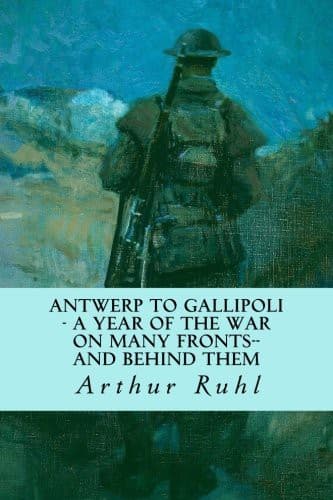
Antwerp to Gallipoli: A Year of the War on Many Fronts—and Behind ThemRuhl, Arthur
History
Antwerp to Gallipoli: A Year of the War on Many Fronts—and Behind Them
Ruhl, Arthur
World War, 1914-1918 -- Personal narratives
You must imagine them coming back from the war, and pale, benign,
leaning on their canes as returning heroes do in plays, talk across the
footlights to real young soldiers you have just seen limping in with
real wounds--pink-cheeked boys with heads and feet bandaged and Iron
Crosses on black-and-white ribbons tucked into their coats, home from
East Prussia or the Aisne. Then between the acts you must imagine them
pouring out to the refreshment-room for a look at each other and
something to eat--will they never stop eating?--fathers and mothers and
daughters with their Butterbrod and Schinken and big glasses of beer in
the genial German fashion, beaming on the young heroes limping by or,
with heads bandaged like schoolboys with mumps, grinning in spite of
their scars.
And when they drift out into the street at last, softened and brought
together by the play--the street with its lights and flags, officers in
long, blue-gray overcoats and soldiers everywhere, and a military
automobile shooting by, perhaps, with its gay "Ta-tee! Ta-td!"--the
extras are out with another Russian army smashed and two more ships sunk
in the Channel. The old newspaper woman at the Friedrichsstrasse corner
is chanting it hoarsely, "Zwei englische Dampfer gesunken!"--and they
read that "the sands have run, the prologue is spoken, the curtain risen
on the tragedy of England's destiny."
Great days, indeed! Days of achievement, of utter sacrifice, and
flinging all into the common cause. Round the corner from Unter den
Linden, under the dark windows of the Information Bureau, you may see
part of the price. It is still and deserted there, except for a lone
woman with a shawl over her head, trying to read, by the light of the
street-lamp, the casualty lists. You must imagine a building like the
Post Office in New York, for instance, or the Auditorium Hotel in
Chicago, with a band of white paper, like newspapers, spread out and
pasted end to end, running along one side, round the corner, and down
the other. Not inches, but yards, rods, two city blocks almost, of
microscopic type; columns of names, arranged in the systematic German
way--lightly wounded, badly wounded--schwer verwundet--gefallen. Some
have died of wounds--tot--some dead in the enemy's country--in
Feindesland gefallen. Rank on rank, blurring off into nothingness,
endless files of type, pale as if the souls of the dead were crowding
here.
One tried to think of the "Categorical Imperative" in a New York
playhouse--of the desperate endeavor to make the young schoolmaster
really look simple and boyish, and yet as if he might have heard of
Kant, and of convincing the two ladies that they lost their sweet
comfortableness by dressing like professional manikins; how the piece
might succeed with luck, or if it could somehow be made fashionable; and
how here, with all the unaffected and affectionate intelligence with
which it was played--and watched--it was but part of the week's work.
Public-domain text, read in full here on John Shaqi.
Reviews
Reviews
No reviews yet
Be the first to share your thoughts on this work.
Elsewhere in the archive
Join the Discussion
Join the discussion
Sign in to leave a comment or review.
Sign InorCreate an account