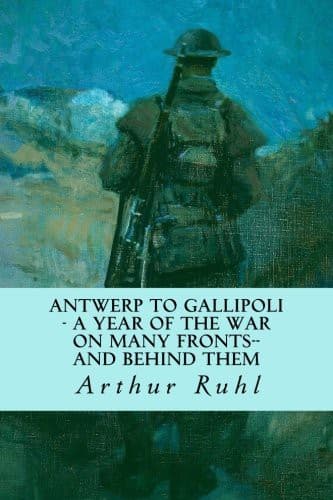
Antwerp to Gallipoli: A Year of the War on Many Fronts—and Behind ThemRuhl, Arthur
History
Antwerp to Gallipoli: A Year of the War on Many Fronts—and Behind Them
Ruhl, Arthur
World War, 1914-1918 -- Personal narratives
You may not like this salute or you may not like the parade step, but
you can be very sure of one thing--that it is not the militarism that
pushes civilians off the sidewalk nor permits an officer to strike his
subordinate--though these things have happened in Germany--that is
holding back England and France and driving the Russian millions out of
East Prussia. It is something bigger than that. Peasants and princes,
these men are dying gladly, backed up by fitness, discipline, and a
passionate unity such as the world has not often seen. This, and not
the futile nurses' tales with which the American public permitted itself
to be diverted during the early weeks of the war, is what strikes one in
Germany. It is a fact, like the Germans being in Belgium, which you
have got to face and think about, whether you like it or not. Berlin,
February, 1915.
Chapter VII
Two German Prison Camps
Visiting a prison camp is somewhat like touching at an island in the
night--one of those tropical islands, for instance, whose curious and
crowded life shows for an instant as your steamer leaves the mail or
takes on a load of deck-hands, and then fades away into a few twinkling
lights and the sound of a bell across the water. You may get permission
to see a prison camp, but may not stay there, and you are not expected,
generally, to talk to the prisoners. You can but walk past those rows
of eyes, with all their untold stories, much as you might go into a
theatre in the midst of a performance, tramp through the audience and
out again.
It is a strange experience and leaves one hoping that somebody--some
German shut away in the south of France, one of those quick-eyed
Frenchmen in the human zoo at Zossen--is keeping a diary. For while
there have always been prison camps, have there ever been--at least,
since Rome--such menageries as these! Behind the barbed-wire fence at
Zossen--Zossen is one of the prisons near Berlin--there are some fifteen
thousand men. The greater number are Frenchmen, droves of those long
blue turned-back overcoats and red trousers, flowing sluggishly between
the rows of low barracks, Frenchmen of every sort of training and
temperament, swept here like dust by the war into common anonymity. I
do not remember any picture of the war more curious, and, as it were,
uncanny than the first sight of Zossen as our motor came lurching down
the muddy road from Berlin--that huge, forgotten eddy, that slough of
idle, aimless human beings against the gray March sky, milling slowly
round and round in the mud.
Public-domain text, read in full here on John Shaqi.
Reviews
Reviews
No reviews yet
Be the first to share your thoughts on this work.
Elsewhere in the archive
Join the Discussion
Join the discussion
Sign in to leave a comment or review.
Sign InorCreate an account