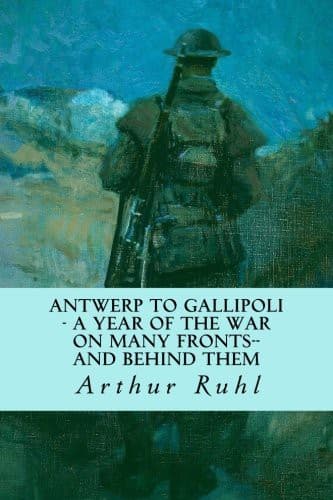
Antwerp to Gallipoli: A Year of the War on Many Fronts—and Behind ThemRuhl, Arthur
History
Antwerp to Gallipoli: A Year of the War on Many Fronts—and Behind Them
Ruhl, Arthur
World War, 1914-1918 -- Personal narratives
It was a dreadful job getting the Frenchmen to take exercise--"they
can't understand why any one should want to work, merely to keep himself
fit!" Aside from this idiosyncrasy they were, of course, the pleasantest
sort of people to get along with. We saw Frenchmen sorting mail in the
post-office, painting signs for streets, making blankets out of pasted-
together newspapers--everywhere they were treated as intelligent men to
whom favors could be granted. And, of course, there was this difference
between the French and English of the early weeks of the war--the French
army is one of universal conscription like the German, and business men
and farmers, writers, singers, and painters were lumped in together.
There was one particularly good-looking young man, a medical officer,
who flung up his head to attention as we came up.
"He helped us a lot--this man!" said the commandant, and laid his hand
on the young man's shoulder. The Frenchman's eyes dilated a trifle and
a smile flashed behind rather than across his face--one could not know
whether it was gratitude or defiance.
A sculptor who had won a prize at Rome and several other artists had had
a room set aside for them to work in. Some were making post-cards, some
more ambitious drawings, and in the sculptor's studio was the head of
the young doctor we had just seen and an unfinished plaster group for a
camp monument. On the wall was a sign in Latin and French--"Unhappy the
spirit which worries about the future," a facetious warning that any one
who loafed there longer than three minutes was likely to be killed, and
the following artistic creed from "La Fontaine:"
"Ne for fans point noire talent. Nous ne ferions rien avec grace. Jamais
un lourdaud quoiqu'il fosse, ne saurait passer pour gallant."
("Don't strain your talent or you'll do nothing gracefully. The boor
won't pass for a gallant gentleman, no matter what he does.")
The Germans, at different times in their history, have conquered the
French and humbly looked up to and imitated them. Generally speaking,
they study and try to understand the French, and their own
intellectuality and idealism are things French-men might be expected to
like or, at any rate, be interested in. Yet it is one of history's or
geography's ironies that the Frenchman goes on his way, neither knowing
nor wanting to know the blond beasts over the Rhine--"Jamais un lourdaud
quoiqu'il fasse" . . the young sculptor must have smiled when he tacked
that verse on the wall of his prison!
Ruhleben is a race-track on the outskirts of Berlin, and a detention
camp for English civilians. This is quite another sort of menagerie.
You can imagine the different kinds of Englishmen who would be caught in
Germany by the storm--luxurious invalids taking the waters at
Baden-Baden; Gold Coast negro roust-abouts from rusty British tramps at
Hamburg; agents, manufacturers, professors, librarians, officers from
Channel boats, students of music and philosophy.
Public-domain text, read in full here on John Shaqi.
Reviews
Reviews
No reviews yet
Be the first to share your thoughts on this work.
Elsewhere in the archive
Join the Discussion
Join the discussion
Sign in to leave a comment or review.
Sign InorCreate an account