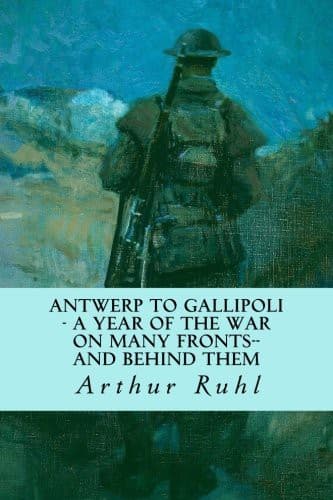
Antwerp to Gallipoli: A Year of the War on Many Fronts—and Behind ThemRuhl, Arthur
History
Antwerp to Gallipoli: A Year of the War on Many Fronts—and Behind Them
Ruhl, Arthur
World War, 1914-1918 -- Personal narratives
We passed a church with a roof smashed by an aeroplane a few days
before--and caught at the same time the first "B-r-r-rurm!" from the
cannonading to the west--a supply-train, an overturned motor-van, and
here and there packed ammunition wagons and guns. Presently, in the lee
of a little brick farmhouse a short distance from the village of Aubers,
we alighted, and, with warnings that it was better not to keep too close
together, walked a little farther down the road. Not a man was in
sight, nor a house, nor gun, not even a trench, yet we were, as a matter
of fact, in the middle of a battle-field. From where we stood it was
not more than a mile to the English trenches and only two miles to Neuve
Chapelle; and even as we stood there, from behind us, from a battery we
had passed without seeing, came a crash and then the long spinning roar
of something milling down aisles of air, and a far-off detonation from
the direction of Neuve Chapelle.
Tssee-ee-rr... Bong! over our heads from the British lines came an
answering wail, and in the field, a quarter of a mile beyond us, there
was a geyser of earth, and slowly floating away a greenish-yellow cloud
of smoke. From all over the horizon came the wail and crash of shells--
an "artillery duel," as the official reports call it, the sort of thing
that goes on day after day.
Somebody wanted to walk on to the desolate village which raised its
smashed walls a few hundred yards down the road. The tall young officer
said that this might not be done--it would draw the enemy's fire, and as
if to accent this advice there was a sudden Bang! and the corner of one
of the houses we were looking at collapsed in a cloud of dust.
Under these wailing parabolas, swinging invisibly across from horizon to
horizon, we withdrew behind the farmhouse for lunch--sandwiches,
frankfurters kept hot in a fireless cooker, and red wine--when far
overhead a double-decker English aeroplane suddenly sailed over us. It
seemed to be about six thousand feet above us, so high that the sound of
its motors was lost, and its speed seemed but a lazy, level drifting
across the blue. Did it take those three motor-cars and those little
dots for some reconnoitring division commander and his staff? Aeroplanes
not only drop bombs, but signal to their friends; there was an
uncomfortable amount of artillery scattered about the country, and we
watched with peculiar interest the movements of this tiny hawk.
But already other guns, as hidden as those that might be threatening us,
had come, as it were, to the rescue. A little ball of black smoke
suddenly puffed out behind that sailing bird, and presently a sharp
crack of a bursting shrapnel shell came down to our ears. Another puff
of smoke, closer, one in front, above, below. They chased round him
like swallows. In all the drab hideousness of modern warfare there is
nothing so airy, so piquant, so pretty as this.
Public-domain text, read in full here on John Shaqi.
Reviews
Reviews
No reviews yet
Be the first to share your thoughts on this work.
Elsewhere in the archive
Join the Discussion
Join the discussion
Sign in to leave a comment or review.
Sign InorCreate an account