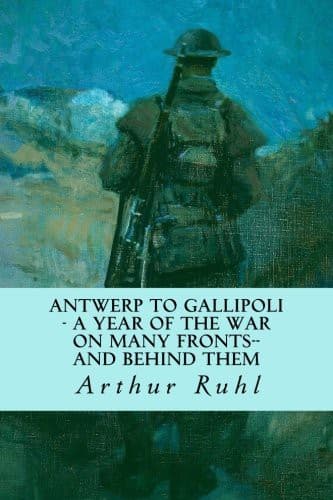
Antwerp to Gallipoli: A Year of the War on Many Fronts—and Behind ThemRuhl, Arthur
History
Antwerp to Gallipoli: A Year of the War on Many Fronts—and Behind Them
Ruhl, Arthur
World War, 1914-1918 -- Personal narratives
He gave me a copy of a speech in which he gladly admitted that he was a
"responsible factor." People talked of going slow and sparing blood.
Well, they might get something by sitting still, even become a great
country, but they could never become a great nation. It was not
territory and population they wanted, but the sword of Rumania to join
in remaking the map of Europe. When the delegates gathered around the
green table, they did not want the one from Rumania, as he was at the
Congress of Berlin, only able to make visits to chancelleries. He must
go in the same door with them, and say: "In proportion to my population,
I have shed as much blood as you."
He had always regretted not having children, never so much as to-day;
but if he had a dozen sons, and knew that all of them would fall in the
war, he would not be cast down. Even if the territory they wished could
be occupied by a simple act of gendarmerie--he would say no--they must
enter Budapest itself (it is only twenty-four hours' railway journey
from Bucarest!)--not till then would Austria admit Rumania's
superiority. People accused him of working for himself. Who was Take
Ionesco in comparison with the fate of a race? As for ambition, well, he
had one, and only one--he wanted to see the Rumanian tricolor floating
from Buda palace, and before he died to know the moment in which he
could pass before his eyes the eighteen hundred years of Rumanian
history from the arrival of Trajan at Severin to the entry of Ferdinand
at Budapest, and cry: "Now, Lord, let thy servant go in peace, for mine
eyes have seen the saving of my race!"
The Rumanian tricolor was no nearer Buda palace when I returned several
months later, but Mr. Ionesco was no less hot for war. Even if Germany
won, he said, they still should go in, because they would at least keep
their own and Germany's respect. "Go to war?"--the phrase was inexact.
"We have been at war for eleven months, only others are firing at us,
but we are not firing at them. We are in a war that will decide our
existence, but the soldiers dying to defend our rights, instead of being
our soldiers, are soldiers of the Allies. The Allies will win, but if
any one thinks that, having won without us, they will have won for us,
he must be mad. Their victory without us may preserve our material
life, but it will never save our moral life nor that of future
generations."
Public-domain text, read in full here on John Shaqi.
Reviews
Reviews
No reviews yet
Be the first to share your thoughts on this work.
Elsewhere in the archive
Join the Discussion
Join the discussion
Sign in to leave a comment or review.
Sign InorCreate an account