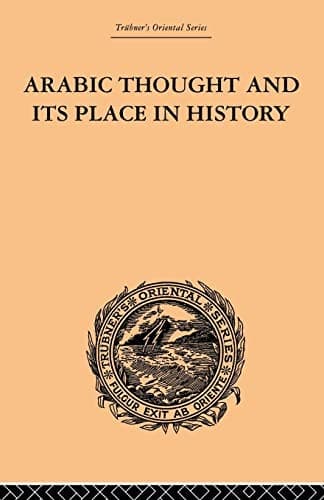
Arabic Thought and Its Place in HistoryO'Leary, De Lacy
ReligionIslamic
Arabic Thought and Its Place in History
O'Leary, De Lacy
Philosophy, Arab
At the beginning of the sixth century A.H., a younger contemporary
of al-Ghazali, we have _Abu Bakr ibn Bajja_ (d. 533 A.H. = 1138
A.D.), the first of the Muslim philosophers of Spain. By this time,
some three-quarters of a century after the death of Ibn Sina,
Arabic philosophy was almost extinct in Asia and was treated as a
dangerous heresy. In Egypt, it is true, there was a greater degree of
toleration, though less than in the golden age of the Fatimids, but
Egypt was regarded with suspicion as the home of heresy and of forms
of superstition which were uncongenial to the philosopher. Spain thus
becomes the place of refuge for Muslim philosophy as it had already
become the nursery of Jewish speculation. Ibn Bajja, known to the
Latin schoolmen as “Avempace,” found in Murabit Spain the freedom
and toleration which Asia no longer afforded. He continues the work
of al-Farabi, not, it will be noted, of Ibn Sina, and develops the
neo-Platonic interpretation of Aristotle on sober and conservative
lines. He wrote commentaries on Aristotle’s Physics, _de generatione
et corruptione_, and the _Meteora_; he produced original works on
mathematics, on “the soul,” and a treatise which he called “The
Hermit’s Guide,” which was used by Ibn Rushd (Averroes) and by the
Jewish writer Moses of Narbonne in the 14th cent. A.D. In this last
work he makes a distinction between “animal activity,” in which action
is due to the prompting of the emotions, passions, etc., and “human
activity,” which is suggested and directed by abstract reason, and from
this distinction draws a rule of life and conduct. He is chiefly cited
by the Latin schoolmen with reference to the doctrine of “separate
substances.” “Avempace held that, by the study of the speculative
sciences, we are able by means of the images which we know from these
ideas to attain to the knowledge of separate substances” (St. Thomas
Aq. _c. Gentiles_, 3, 41). This question as to the possibility of
knowing substances separated, i.e. abstracted, from the concrete bodies
in which they exist in combination--and the “separate substances” were
regarded as spiritual things--was prominent in mediæval scholasticism,
which inherited it from the Arabic philosophers, and from it came the
further question whether the contemplation of such abstract ideas gives
us a better knowledge of realities than observation of the concrete
bodies. Both Albertus Magnus and St. Thomas Aquinas associate Avempace
especially with this question and with the doctrine of the “acquired
intellect,” to which we have already referred in our notes on Ibn Sina,
and which completes the theory of “separate substances” by supposing
that intelligible forms stream into our souls from an outside Agent
Intellect by way of emanation as substantial forms descend on corporeal
matter. St. Thomas Aquinas shows direct knowledge of Avempace’s
treatment of these subjects, but this is not so evident in Albertus.
Public-domain text, read in full here on John Shaqi.
Reviews
Reviews
No reviews yet
Be the first to share your thoughts on this work.
Elsewhere in the archive
Join the Discussion
Join the discussion
Sign in to leave a comment or review.
Sign InorCreate an account