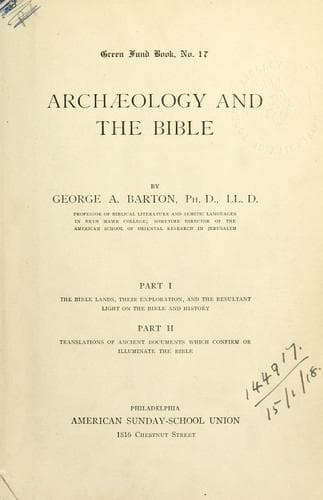
Archæology and the BibleBarton, George A. (George Aaron)
Religion
Archæology and the Bible
Barton, George A. (George Aaron)
Bible -- Antiquities; Egypt -- Antiquities; Middle East -- Antiquities
(2) _The Destruction of Jerusalem in 70 A. D._--Roman rule was always
distasteful to the Jews, and as the years passed they became more and more
restive. These smouldering fires broke into the flame of open rebellion in
the year 66 A. D., and after four years of terrible warfare Jerusalem was
captured and destroyed in 70 A. D. The temple, also razed to the ground,
has never been rebuilt. The country about Jerusalem was peopled by some of
the poorer of the peasantry, and the tenth Roman legion remained in the
city for a long time to keep order in that region.
=12. Later History.=--In 132 A. D., in the reign of Hadrian, a man called
Bar Chocaba, or the “Son of the Star,” came forward, claiming to be the
Messiah, and headed a Jewish revolt. So fiercely did the Jews fight that
the insurrection was not quelled by Rome until 135 A. D. When it was
finally put down, Hadrian determined to blot the name of Jerusalem from
the map. He rebuilt Jerusalem, making it a Roman colony, named it Ælia
Capitolina, and built a temple to Jupiter on the spot where the temple of
Jehovah had formerly stood. No Jew was permitted to come near the city.
Jerusalem as built by Hadrian continued until the time of Constantine, and
the form thus imposed upon it lasted much longer.
When Constantine made Christianity the religion of the empire, both he and
his mother began to take an interest in the Holy City and the Holy Land.
Other Christians followed them. The Church of the Holy Sepulcher was
built, and the temple of Jupiter built by Hadrian was turned into a
Christian church. Pilgrimages to the Holy Land began, and monasteries,
churches, and bishoprics in time sprang up over all the country. Thus for
three hundred years the influences which were felt in Palestine emanated
from Byzantium or Constantinople. In 615 A. D. the land was overrun by
Chosroes II of Persia, who captured Jerusalem and destroyed many of its
churches. The Persians held it until 628, when the Byzantine kings
regained it. The control of Jerusalem by the Christians was, however, of
short duration, for in 636 Palestine was captured by the Mohammedans, and
with the exception of 89 years has ever since been under Mohammedan
control.[131] During these long centuries the country was ruled by the
Caliphs of Medina, Damascus, and Bagdad; by the Buvide Sultans, the
Fatimite Caliphs of Egypt, and the Seljuk Turks. The cruelties inflicted
by these last rulers upon Christians led to the Crusades, the first of
which established the Latin kingdom of Jerusalem,[132] which continued
from 1099 to 1188 A. D. This kingdom, organized on the feudal basis then
existing in western Europe, extended over all of Palestine and Syria,
including Antioch, and for nearly half the time, Edessa beyond the
Euphrates. Its existence marks an epoch in the archæology of the country.
Public-domain text, read in full here on John Shaqi.
Reviews
Reviews
No reviews yet
Be the first to share your thoughts on this work.
Elsewhere in the archive
Join the Discussion
Join the discussion
Sign in to leave a comment or review.
Sign InorCreate an account