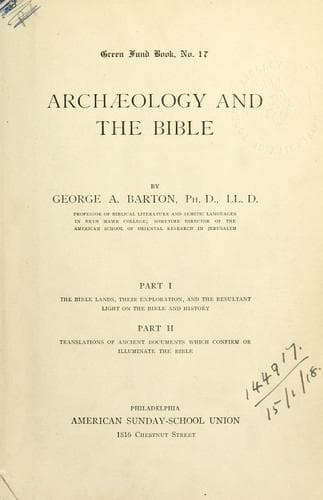
Archæology and the BibleBarton, George A. (George Aaron)
Religion
Archæology and the Bible
Barton, George A. (George Aaron)
Bible -- Antiquities; Egypt -- Antiquities; Middle East -- Antiquities
5. Month of the barley-harvest. (See Ruth 2:23; 2 Sam. 21:9.)
6. Month of the harvest of all [other grains?].
7. Month of pruning [vines].
8. Month of summer-fruit [figs].
This calendar, beginning in October, still conforms to the agricultural
pursuits of the year. It also gives us archæological evidence of the
culture of flax by the ancient Israelites. (See Josh. 2:6; Prov. 31:13;
Hosea 2:5, 9.)
(12) _Domestic Animals._--The domestic animals of ancient Palestine may be
traced in part by their bones found in various excavations, and in part by
the pictures of them drawn in caves and tombs. The domestic animals most
often mentioned in the Bible are asses, cattle, sheep, goats, and camels.
Bones, pictures, or models of these were found in all the strata of
Gezer.[164] There seem to have been a variety of cows; the breeds varied
in the different periods. No horse bones were found until the third
Semitic period (1350-1000 B. C.). It was, perhaps, during that period that
the horse was introduced by the Hittites, who appear to have brought it
from Turkestan, where its bones have been found in much earlier
strata.[165] The ass was, however, the common beast of burden in
Palestine, and bones of horses are rare until the Greek period. A number
of figures of horses’ heads with their bridles were found, as well as a
horse’s bit, and the picture of a horse and his rider. The pig was a
domesticated animal of the primitive cave-dwellers of Gezer, who appear to
have offered swine in sacrifice, but pig-bones are rarely found in the
Semitic strata. As swine were unclean to all Semites, this is not strange.
The dog appears to have been half-domesticated, as the Bible implies, as
his bones were employed for making prickers and similar tools, but no
pictures or models of dogs are known to the writer. Probably they were of
the half-wild pariah type. Certainly they were not held in high esteem.
(See 1 Sam. 17:43; 2 Sam. 16:9.) For illustrations, see Figs. 89-92.
(13) _Bees._--A number of inverted jars, each pierced with a number of
circular holes, were found. It seems probable that these were rude
beehives. Before the Israelites settled in Palestine they knew it as “a
land flowing with milk and honey” (Exod. 3:8, 17; Num. 14:8; 16:13, 14;
Deut. 6:3), and their view was, we are told, shared by others (2 Kings
18:32). It is not surprising, therefore, to find evidences of bee culture;
(see Fig. 95).
Public-domain text, read in full here on John Shaqi.
Reviews
Reviews
No reviews yet
Be the first to share your thoughts on this work.
Elsewhere in the archive
Join the Discussion
Join the discussion
Sign in to leave a comment or review.
Sign InorCreate an account