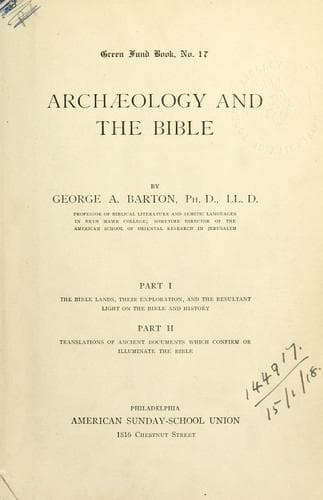
Archæology and the BibleBarton, George A. (George Aaron)
Religion
Archæology and the Bible
Barton, George A. (George Aaron)
Bible -- Antiquities; Egypt -- Antiquities; Middle East -- Antiquities
(8) _Anklets_ of bronze and silver have also been found in various places.
They are like bracelets, only larger. In a country where the ankles were
usually left bare, it was as natural to wear ornaments on them as on the
arms. These, too, are denounced along with the other ornaments of women in
Isa. 3:18.
(9) _Rings_, too, of various kinds have been found in profusion. Most of
the finger rings were simple circles of metal; usually they were of
bronze; sometimes of iron. Silver and gold rings were comparatively few in
number and of small size. Several signet rings were found at Gezer. Finger
rings are not often mentioned in the Bible. (See, however, Num. 31:50.)
They evidently were highly regarded by well-to-do people, for in the
Parable of the Prodigal Son Jesus tells us that the father “put a ring on
his hand” (Luke 15:22). Signet rings were the possessions of the great and
of kings. (See Gen. 41:42 and Esther 3:10, 12, and Fig. 184.)
CHAPTER X
MEASURES, WEIGHTS, AND MONEY
MEASURES. WEIGHTS. INSCRIBED WEIGHTS. MONEY: Who invented coinage?
Darics. Maccabæan coins. Asmonæan coins. Herodian coins. Roman coins.
The Widow’s Mite. The Piece of Silver. Coinage of the Revolt of 66-70
A. D.
=1. Measures.=--The Hebrew units of dry measure were: 1. The Homer (or
Cor), which contained 10 Ephahs (Ezek. 45:11, 14). 2. The Ephah, which
contained 3 Seahs (Isa. 40:12) or 10 Omers (Exod. 16:36) or 18 Cabs (2
Kings 6:25, and Josephus, _Antiquities_, IX, iv, 4).
Corresponding to these were the units of liquid measure: 1. The Homer (or
Cor), which contained 10 Baths (Ezek. 45:11, 14). 2. The Bath, which,
according to Josephus and Jerome, contained 6 Hins (see Exod. 29:40). 3.
The Hin, which contained 3 Cabs, or, according to the Talmud, 12 Logs.
These two systems have the Homer as their major unit. The Homer had the
same capacity in each system. The Ephah of dry measure equalled the Bath
of liquid measure, and the Cab was the same in each. If, then, the
capacity of one unit in either measure could be determined, we should know
the capacity of all the others.
It has been the custom of archæologists to strike a kind of average of the
confused statements of Josephus and Epiphanius[178] and correct these by
estimates based on Babylonian measures.
Calculations based on this method will be found in recent works on Hebrew
archæology and dictionaries of the Bible. It has been impossible, however,
to reach certainty. Three systems will be found in the books referred to:
one based on the supposition that the Log = 9/10 of a pint; one based on
the supposition that the Log = 91/100 of a pint; the third on the
supposition that the Log = 1 pint. The estimates of the Homer vary
accordingly from 80 gallons to 81.25 gallons, and 89.28 gallons.[179]
Public-domain text, read in full here on John Shaqi.
Reviews
Reviews
No reviews yet
Be the first to share your thoughts on this work.
Elsewhere in the archive
Join the Discussion
Join the discussion
Sign in to leave a comment or review.
Sign InorCreate an account