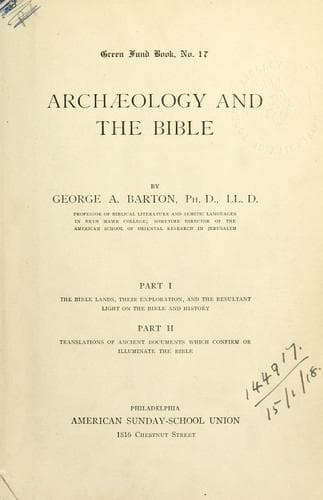
Archæology and the BibleBarton, George A. (George Aaron)
Religion
Archæology and the Bible
Barton, George A. (George Aaron)
Bible -- Antiquities; Egypt -- Antiquities; Middle East -- Antiquities
A glance at the weights here described makes it evident that the standards
of the ancient Hebrews were not exact. If these are representative
weights, the shekel must have varied from 200 to more than 300 grains
Troy. This is what one acquainted with the Palestine of today would
expect. The peasants still use field-stone as weights, selecting one that
is approximately of the weight they desire. Even among the merchants of
modern Jerusalem, where one would expect more exact standards than among
the peasantry, odd scraps of old iron are used for weights.[186]
A large number of uninscribed weights of the same general size and shape
of those described[187] were found at Gezer. Whether larger weights or
multiples of a shekel were discovered is uncertain. A number of stones
might have been used for weights, but they were not inscribed and may have
been used for other purposes. A large bronze weight found at Tell
Sandahanna is just sixty times the weight of a 311-grain shekel, and may
be a mana.[188]
Where weights and measures differed so, the words of Amos (8:5), “making
the ephah small and the shekel great,” gain an added significance, and we
understand why the wise man denounced “false balances” (Prov. 11:1;
20:23). Indeed, of the weights found at Gezer so many were under the
average standard, and so many above it, that the inference lay close at
hand that many men had one set of weights by which to purchase and another
set by which to sell.[189]
=4. Money.=--Down to the seventh century before Christ money was not
coined. Whenever it was employed as a medium of exchange, it was weighed.
In western Asia and Egypt our sources show that in the period from 1500 to
1300 B. C. gold and silver were prepared for commercial use by being
formed into rings.[190] These rings were of no standard weight; they were
weighed in the mass by scales. Probably the rings were small, so that the
weight could, at the will of the merchant, be increased by very slight
amounts. The ring-form was probably selected because this shape would
present no corners that would rapidly wear away. This type of commercial
ring can be traced in the inscriptions of Ashurnasirpal II of
Assyria,[191] 884-860 B. C. It was used, then, in Egypt, Syria, Phœnicia,
by the Hittites, the Aramæans, and the Assyrians.
Public-domain text, read in full here on John Shaqi.
Reviews
Reviews
No reviews yet
Be the first to share your thoughts on this work.
Elsewhere in the archive
Join the Discussion
Join the discussion
Sign in to leave a comment or review.
Sign InorCreate an account