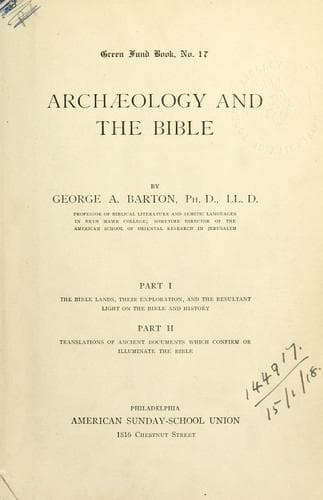
Archæology and the BibleBarton, George A. (George Aaron)
Religion
Archæology and the Bible
Barton, George A. (George Aaron)
Bible -- Antiquities; Egypt -- Antiquities; Middle East -- Antiquities
(2) _David’s Reign._--As David’s reign advanced and his success in war
compelled neighboring nations to pay tribute, probably the population of
Jerusalem increased. Such an increase would naturally lead to the erection
of houses outside the walls, as it has in recent times. It is altogether
probable that a settlement on the western hill was thus begun in the reign
of David. There is no hint, however, that he took any steps to enclose
such a settlement within a wall. The phrase “the way of the gate” in 2
Sam. 15:2 implies that there was still but one gate in the walls. This is
in striking contrast to the number of gates in later times. The only
record that we have of further action on David’s part that affected the
future growth of Jerusalem refers to the way in which he took over the
rock on Mount Moriah and the sacred cave under it and made a sanctuary to
Jehovah. (See 2 Sam. 24.) This action, at a later time, determined the
site of the temple.
=7. Solomon’s Jerusalem.=--David left Jerusalem a military fortress;
Solomon transformed it into a city with imposing buildings. This creation
of a more imposing city was in accord with the general character of
Solomon’s reign. He established a large harem, made marriage alliances
with many neighboring kings, maintained such an establishment that it was
necessary to make a regular levy on a different portion of the country
each month for supplies, and endeavored to make his capital as splendid as
the capital of a rich commercial Phœnician monarch. Such a policy
necessitated, probably, the enlargement of Jerusalem. David, who began
life as a shepherd-boy, was content to live the simple life to the end;
Solomon, born to the purple, desired to surround himself with a pomp
befitting his rank. The Biblical writers were more interested in the
construction of the temple and of Solomon’s palace than in any other phase
of his work, but they have left us some hints of his activities in other
directions.
Public-domain text, read in full here on John Shaqi.
Reviews
Reviews
No reviews yet
Be the first to share your thoughts on this work.
Elsewhere in the archive
Join the Discussion
Join the discussion
Sign in to leave a comment or review.
Sign InorCreate an account