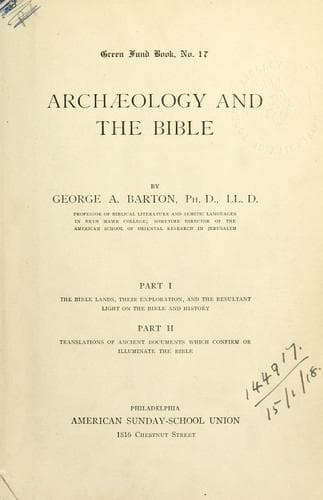
Archæology and the BibleBarton, George A. (George Aaron)
Religion
Archæology and the Bible
Barton, George A. (George Aaron)
Bible -- Antiquities; Egypt -- Antiquities; Middle East -- Antiquities
The enclosure of this hill-top with a wall set it apart from the rest of
Jerusalem. It was a kind of separate fortress. At the time it emphasized
the majesty of Solomon--his apartness from his people. This separate
enclosure of the temple hill was perpetuated through the whole history of
Jerusalem and is maintained today. In all periods the temple hill has been
a fortress that could be defended apart from the city.
(2) _Solomon’s Temple._--Of the form and situation of the buildings of
Solomon on the hill that was enclosed by this new wall, there is a wide
diversity of opinion. This diversity arises in part from the fact that
some scholars take at their face value statements of Josephus, the Talmud,
and other late sources concerning Solomon’s temple, while others attribute
less weight to the statements of those sources which were written long
after this temple was destroyed, and base their views rather on the
earlier documents. The last is the only sound method of study, and is the
course followed here. We shall take as evidence of the plan and situation
of the buildings the Biblical writers who had seen them.
We are at the start confronted, however, with a difficulty, since no
Biblical writer has given us an exact statement as to what part of the
hill Solomon’s temple occupied. Most modern scholars hold, nevertheless,
that it was built at the highest point of the hill just west of the sacred
cave, which has already been mentioned,[241] and the old rock-altar above
it. This view is confirmed by Josephus[242] and is undoubtedly correct,
although three or four modern scholars have doubted it. The temple would
naturally be built near the spot where the angel is said to have appeared
to David (2 Sam. 24:16), and as angels are frequently represented in the
Old Testament as appearing upon rocks (see Judges 6:11, f.; 13:19)[243] it
is altogether probable that the appearance to David was on the rock-altar
at the top of the hill. On this rock the animals for sacrifice were slain,
as the conduits for blood still visible on its top indicate. Near it,
then, or on it the altar of burnt-offerings stood. We learn from Ezekiel,
who had served as a priest in the temple of Solomon, that the temple faced
the east, that it stood to the west of the altar, and that there was room
between the temple and the altar for twenty-five men. (See Ezek. 8:16.)
The temple was a rectangular building with its greatest length running
east and west. Its measurements were 124 feet for the length, 50 for the
breadth, and 55 for the height. It was constructed of stones and cedar
beams. The outer temple, afterward called the holy place, was 70 feet
long, 34½ feet wide, and 52 feet high. Back of it was the holy of holies,
where the ark was placed. It was a cube 34½ feet each way. Apparently
there was a chamber above it.[244] This room was adorned with carvings of
cherubim, palms, and open flowers (1 Kings 6:29, 32, 35). It had no
window. According to 2 Chron.
Public-domain text, read in full here on John Shaqi.
Reviews
Reviews
No reviews yet
Be the first to share your thoughts on this work.
Elsewhere in the archive
Join the Discussion
Join the discussion
Sign in to leave a comment or review.
Sign InorCreate an account