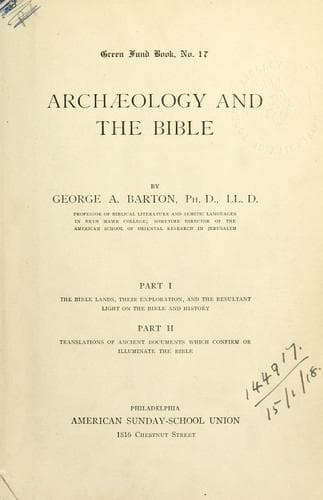
Archæology and the BibleBarton, George A. (George Aaron)
Religion
Archæology and the Bible
Barton, George A. (George Aaron)
Bible -- Antiquities; Egypt -- Antiquities; Middle East -- Antiquities
One of the Asmonæans, probably John Hyrcanus I, built a palace in
Jerusalem.[267] This palace apparently stood on the site now occupied by
the Synagogue of the German Jews in Jerusalem.[268] It was connected with
the temple area by a bridge,[269] of which a remnant of the easternmost
span, now called “Robinson’s Arch,”[270] is still visible on the western
wall of the temple enclosure. This bridge was destroyed by Pompey when he
captured Jerusalem in 63 B. C.,[271] and its remains were found by Warren
in the bottom of the Tyropœon valley, 80 feet below the present surface of
the ground.[272] As the Asmonæans were high priests as well as kings, this
bridge gave them easy access to the temple from their palace. The palace
itself, situated on a part of the western hill that overtopped the temple
hill, was so placed that the royal priest could sit in his palace and
watch what was transpiring in the temple courts and in the valley below.
The third accomplishment of the Asmonæans was probably the construction of
Solomon’s Pools and the High Level Aqueduct by which the water was brought
into Jerusalem.[273] This work appears also to have been accomplished by
John Hyrcanus I, for Timarchus, the biographer of Antiochus VII, who was a
contemporary of Hyrcanus I, says of Jerusalem that “the whole city runs
down with waters, so that even the gardens are irrigated by the water
which flows off from it.”[274] Such a description would be quite
unfitting, if all the water had been supplied by Gihon, En-rogel, and the
cisterns about Jerusalem. It implies that a perpetual stream of water,
such as came through one of the aqueducts, flowed into the city.
One other structure is attributed to an Asmonæan. Alexander Jannæus was
very unpopular with the Pharisees, and once, as already noted, he was
pelted by the people with citrons. He thereupon erected a wooden barrier
around the temple and the altar, thus excluding the laity from a close
approach to the temple,[275] and creating a court for the priests alone.
Jerusalem suffered from four sieges in the troublous days when the
Asmonæan power was waning and that of Rome was being established. The
first was by Haretat, King of the Nabathæans, in 65 B. C., but was lifted
without result.[276] The second was that of Pompey in 63 B. C. It resulted
in the capture of the city and in considerable damage. The bridge across
the Tyropœon to the royal palace was broken down.[277] The third was that
of the Partisans in 40 B. C., when they captured the city and placed
Antigonus, son of Aristobulus II, on the throne.[278] The fourth was that
by which Herod the Great became master of Jerusalem in 37 B. C. At this
time a part of the two northern walls were broken down.[279] The
topography of the city was in no way changed until after the conquest by
Herod, who changed the face of Jerusalem in many ways.
Public-domain text, read in full here on John Shaqi.
Reviews
Reviews
No reviews yet
Be the first to share your thoughts on this work.
Elsewhere in the archive
Join the Discussion
Join the discussion
Sign in to leave a comment or review.
Sign InorCreate an account