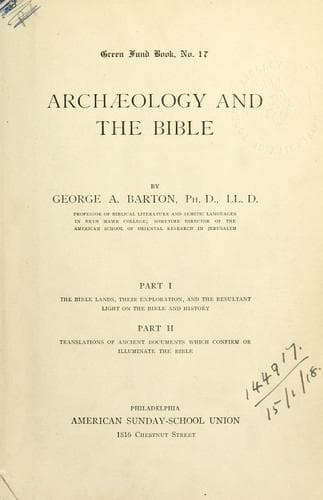
Archæology and the BibleBarton, George A. (George Aaron)
Religion
Archæology and the Bible
Barton, George A. (George Aaron)
Bible -- Antiquities; Egypt -- Antiquities; Middle East -- Antiquities
=3. Scythopolis= was the only one of the cities of the Decapolis west of
the Jordan. It was on the site of the Beth-shean of the Old Testament
(Josh. 17:11; 1 Sam. 31:10, 12; 2 Sam. 21:12; 1 Kings 4:12). Beth-shean
was already a city at the time Palestine was conquered by Thothmes
III[299] and there has apparently been a town near this spot ever since.
It seems to have been called Scythopolis by the successors of Alexander
the Great, probably because a group of Scythians had taken the city and
settled there. When it came into the possession of Scythians we can only
conjecture, but it was probably at the time of the great Scythian invasion
of Palestine, about 625-615 B. C. This invasion called forth the dark
prophecies of the book of Zephaniah. Scythopolis appears from certain
coins[300] to have become a Hellenic city in the time of Alexander the
Great. In the time of Ptolemy Euergetes I, 247-222 B. C., it was subject
to Egypt,[301] but it passed to the dominions of the Seleucidæ of Antioch
in 198 B. C. Upon the break-up of the Syrian empire in 65-63 B. C., Pompey
made it one of the cities of the Decapolis.
The remains of the Hellenic city have now entirely disappeared with the
exception of the great stone amphitheater. This may still be seen[302] in
the valley on the south side of the mound which covers the ruins of the
ancient Beth-shean, where it is overgrown with briers. The name
Scythopolis has long since disappeared, and the old Hebrew name for the
place still survives in the name of the modern town Beisan. This modern
town is situated on the south side of the valley mentioned above, a little
distance from the mound which covers the ancient city. Scythopolis was
situated at the point where the plain of Jezreel or Esdraelon joins the
Jordan valley. In the time of Christ the Jews from Nazareth and its
vicinity, when going to the three annual festivals at Jerusalem, came down
the plain and then followed the Jordan valley down to Jericho (see Luke
19:1), in order to avoid going through Samaria. From the time that Jesus
was twelve years old he must, therefore, have often passed by Scythopolis
on his way to Jerusalem. As it was a Gentile town, however, neither he nor
his companions would enter it on such occasions, as they would thereby be
rendered unclean.
=4. Cities East of the Sea of Galilee.=--To the east of the Sea of Galilee
lay three of the cities of the Decapolis. Hippos was comparatively near
the sea, where Susiye now lies. The Jews of the Talmudic period called the
place Susitha.[303] Hippos is the Greek for horse. Susitha is a Hebrew
translation of this and Susiye is an Arabic corruption of the Hebrew. All
traces of the ancient Hippos except the name have disappeared.
Public-domain text, read in full here on John Shaqi.
Reviews
Reviews
No reviews yet
Be the first to share your thoughts on this work.
Elsewhere in the archive
Join the Discussion
Join the discussion
Sign in to leave a comment or review.
Sign InorCreate an account