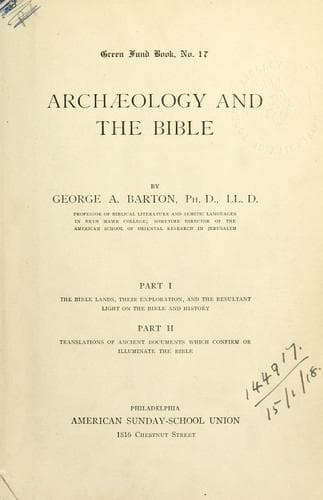
Archæology and the BibleBarton, George A. (George Aaron)
Religion
Archæology and the Bible
Barton, George A. (George Aaron)
Bible -- Antiquities; Egypt -- Antiquities; Middle East -- Antiquities
Again, toward the end of the ministry of Jesus, after he had withdrawn for
a time to Phœnicia, he returned by crossing the high lands of northern
Galilee and coming down east of the Jordan “through the midst of the
borders of Decapolis” (Mark 7:31).
CHAPTER XV
ATHENS, CORINTH, AND THE CHURCHES OF ASIA
ATHENS. CORINTH. THE CHURCHES OF ASIA: Ephesus. Pergamum. Thyatira.
Sardis. Philadelphia. Smyrna. Laodicea.
The greater part of Biblical history was enacted in Palestine and the
great valleys of Mesopotamia and the Nile. The Apostle Paul, however,
broke the Jewish bonds of primitive Christianity and carried the Gospel to
the coasts of the Ægean Sea. In cities of this region he spent years of
his active missionary life; to churches of this region most of his
epistles were sent, and to churches of this part of the world the seven
messages to the churches were addressed. We cannot, therefore, conclude
this sketch of what archæology has done to throw light upon the Bible
without saying a few words concerning exploration and excavations in
certain parts of Greece and Asia Minor. It will be impossible for lack of
space to go thoroughly into the history of this region, but as these lands
were not, like Egypt, Babylonia, Assyria, and Palestine, closely connected
with Biblical history for a long period, detailed history of them before
the Apostolic age will not be missed by the student of the Bible.
The results of scattered discoveries at Thessalonica and elsewhere will be
presented in Part II, Chapter XXVII. At this point attention will be
directed to a few important cities.
=1. Athens=, the chief city of Attica, one of the least productive parts
of Greece, is the far-famed mistress of the world’s culture and art.
Emerging from obscurity in the seventh century before Christ, gaining a
position of leadership in the Persian wars after 500 B. C., Athens
established a considerable empire. In this period fell the age of
Pericles, 460-429 B. C., when the artistic and literary genius of Athens
reached a height never equaled in human history. Socrates was born here in
469 and lived till 399 B. C. Here Plato, who was born about 428, became a
pupil of Socrates and afterward taught. Hither came Aristotle, after the
year 367, to sit at Plato’s feet. Here from the age of Pericles the
acropolis was crowned with those architectural creations that are at once
the admiration and the despair of the world; (see Fig. 277). It stirs the
imagination to think of Paul in such a city.
Public-domain text, read in full here on John Shaqi.
Reviews
Reviews
No reviews yet
Be the first to share your thoughts on this work.
Elsewhere in the archive
Join the Discussion
Join the discussion
Sign in to leave a comment or review.
Sign InorCreate an account