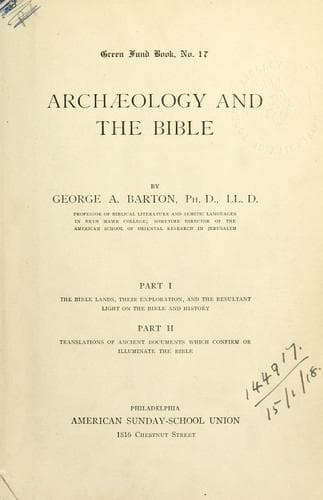
Archæology and the BibleBarton, George A. (George Aaron)
Religion
Archæology and the Bible
Barton, George A. (George Aaron)
Bible -- Antiquities; Egypt -- Antiquities; Middle East -- Antiquities
Philadelphia was founded by Attalus II, King of Pergamum, 159-138 B. C.,
who was called Philadelphus because of his devotion to his predecessor and
brother, Eumenes II. Hence the city was named Philadelphia. It was founded
for the purpose of spreading Hellenism in the eastern part of Lydia, and
so was a missionary city from the first. With the other Pergamene
territories it became a dependency of Rome in 133 B. C. In 17 A. D. it
suffered severely from the same earthquake that destroyed Sardis. Indeed,
at Philadelphia the quakings were even more severe. The trembling of the
earth lasted for a long time. When Strabo wrote in 20 A. D. earthquake
shocks at Philadelphia were an every-day occurrence. Few people lived in
the city; most of the inhabitants spent their time outside.[348] Allusion
to this is, perhaps, made in Rev. 3:12: “he shall go out thence no more.”
After the earthquake the city appealed to Rome for help. Tiberius granted
it and also permitted the city to change its name to Neocæsarea, or the
city of the young Cæsar.[349] This, too, seems to be alluded to in Rev.
3:12, where another new name is to be conferred.
At Ala-Sheher a part of the city wall of Philadelphia may still be traced,
and the sites of the acropolis, the theater, and the stadium may also be
seen, as well as the ruins of an old Christian church.[350]
(6) _Smyrna_, at the mouth of the Hermus, is one of the very old cities of
Asia Minor. A colony of Æolian Greeks founded a city here more than a
thousand years before Christ. A little later the place was captured by
Ionian Greeks, who held it till about 600 B. C., when it was conquered by
the kings of Lydia and destroyed.[351] For three hundred years the name
designated a district rather than a city. Lysimachus, the general of
Alexander the Great who became king of Thrace (301-282 B. C.), refounded
Smyrna as a Greek city about three miles southwest of the old site, and it
has continued ever since to be an important seaport of Asia Minor. It
passed with the other cities of the region successively under the sway of
the kings of Syria, the kings of Pergamum, and of Rome. Smyrna is today
one of the largest cities of the East with a population of between two and
three hundred thousand.
Smyrna claimed to be the birthplace of Homer. Ælius Aristides (born 117 A.
D.), who lived at Smyrna, several times likens the city to a crown, and
apparently the crown was in some way associated with Smyrna; (see Fig.
287). The goddess of the place, who was a kind of Cybele, is pictured as
wearing a crown.[352] This is, no doubt, the reason why in Rev. 2:10 a
crown of life is promised to the church of Smyrna if she is faithful. No
excavations have been made at Smyrna, but above the city the tomb of
Polycarp,[353] said in tradition to have been a disciple of the Apostle
John, is shown. Polycarp was martyred in 155 A. D. in one of those times
of tribulation predicted in Rev. 2:10.
Public-domain text, read in full here on John Shaqi.
Reviews
Reviews
No reviews yet
Be the first to share your thoughts on this work.
Elsewhere in the archive
Join the Discussion
Join the discussion
Sign in to leave a comment or review.
Sign InorCreate an account