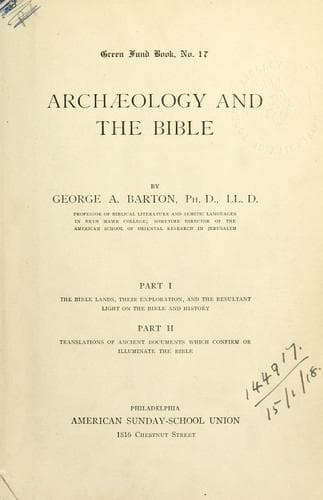
Archæology and the BibleBarton, George A. (George Aaron)
Religion
Archæology and the Bible
Barton, George A. (George Aaron)
Bible -- Antiquities; Egypt -- Antiquities; Middle East -- Antiquities
As this account does not so closely resemble that in Genesis, it is not
translated here. Those who wish to read it are referred to Rogers,
_Cuneiform Parallels to the Old Testament_, New York, 1912, p. 114, ff.
CHAPTER VII
AN ACCOUNT OF THE CREATION AND FLOOD, FROM A TABLET WRITTEN AT NIPPUR
BEFORE 2000 B. C.
TRANSLATION. COMPARISON WITH THE OTHER VERSION.
=1. Translation.=
This tablet was published by Dr. Arno Poebel, of Breslau. It was
apparently written in the time of the dynasty of Nisin, but at any rate
not later than the period of the first dynasty of Babylon. Only a part of
the tablet has been found, so that the narrative is incomplete both at the
beginning and at the end. Possibly the remaining portion may some time be
found in the museum at Constantinople. The tablet is inscribed on both
sides, and there are three columns to the side. The portions that are
still extant read as follows:[400]
_Column I (about three-fourths of the column missing)_
..........................................
..........................................
“My human-kind from its destruction I will [raise up];
With the aid of Nintu my creation .......... I will raise up;
The people in their settlements I will establish;
The city, wherever man creates one--indeed its protection--therein I
will give him rest.
Our house--its brick may he cast in a clean spot!
Our places in a clean place may he establish!”
Its brilliant splendor, the temple platform, he made straight,
The exalted regulations he completed for it;
The land he divided; a favorable plan he established.
After Anu, Enlil,[401] Enki,[402] and Ninkharsag
The black-headed[403] race had created,
All that is from the earth, from the earth they caused to spring,
Cattle and beasts of the field suitably they brought into being.
Here the first column ends. The passage opens in the midst of the speech
of some deity--perhaps Ninkharsag (a Sumerian name of Ishtar) or possibly
Enlil, the god of Nippur. First the deity tells how mankind, which has
been overthrown, shall be raised up again. Then we are told how he
perfected plans for the accomplishment of this purpose, and lastly how
four deities called into being men and animals.
_Column II (about three-fifths of the text is missing)_
Public-domain text, read in full here on John Shaqi.
Reviews
Reviews
No reviews yet
Be the first to share your thoughts on this work.
Elsewhere in the archive
Join the Discussion
Join the discussion
Sign in to leave a comment or review.
Sign InorCreate an account