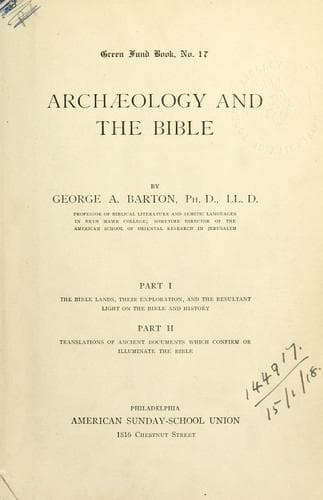
Archæology and the BibleBarton, George A. (George Aaron)
Religion
Archæology and the Bible
Barton, George A. (George Aaron)
Bible -- Antiquities; Egypt -- Antiquities; Middle East -- Antiquities
It is clear from these fragmentary lines that Ziugiddu is being informed
of the approaching deluge. It is also clear that some of the elements of
the narrative are identical with some of the elements of the one discussed
in Chapter VI. Ziugiddu is commanded to stand by a wall, where some deity
will speak to him. This appears in the other version in the form:
“O reed-hut, reed-hut, O wall, wall,[404]
O reed-hut, hearken; O wall, give heed!
O man of Shurippak, son of Ubartutu,
Pull down thy house, build a ship,” etc.
In that account, too, the assembly of the gods is also referred to in line
120, ff. These are examples of the way the same theme, differently
treated, turns up in different forms.
_Column V_
The evil winds, the wind that is hostile, came; all of them descended,
The deluge .......... came on with them
Seven days and seven nights
The deluge swept over the land,
The evil wind made the huge boat tremble.
Shamash[405] came forth, on heaven and earth he shone;
Ziugiddu the ship at the top uncovered,
The peace of Shamash, his light, entered into the boat.
Ziugiddu, the king
Before Shamash bowed his face to the earth.
The king--an ox he sacrificed, a sheep offered as oblation.
.........................................
In this column we have a fragment which relates some details similar to
those told in lines 128, 129, and 136-138 of the account given in Chapter
VI.
_Column VI_
By the life of heaven and the life of earth ye shall conjure him,
That he may raise up from you;
Anu and Enlil by the soul of heaven and the soul of earth ye shall
conjure,
That they may raise up from you
The curse that has come upon the land, that they may remove it.
Ziugiddu the king
Before Anu and Enlil bowed his face to the earth.
Life like a god’s he gave to him,
An immortal spirit like a god’s he brought to him.
Then Ziugiddu the king,
Of the seed that was cursed, lord of mankind he made;
In the fruitful land, the land of Dilmun .......... they made him dwell
.........................................
At this point the last column is hopelessly broken. It is clear, however,
from the part which remains that Ziugiddu is in this narrative translated
to the Isle of the Blest as was Utnapishtim in the account translated in
Chapter VI, lines 202-205.[406] Indeed there is reason to believe that the
two accounts of the flood are divergent versions of the same story. In
addition to the likenesses already mentioned, the names of the two heroes,
though they appear so different, are the same in meaning. Utnapishtim (or
Unapishtim) means “day of life,” or “day-life,” while Ziugiddu means
“Life-day prolonged.”
=2. Comparison with the Other Version.=
Public-domain text, read in full here on John Shaqi.
Reviews
Reviews
No reviews yet
Be the first to share your thoughts on this work.
Elsewhere in the archive
Join the Discussion
Join the discussion
Sign in to leave a comment or review.
Sign InorCreate an account