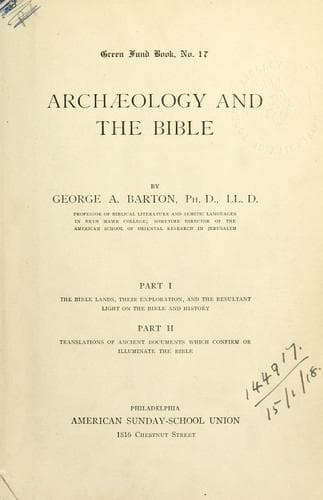
Archæology and the BibleBarton, George A. (George Aaron)
Religion
Archæology and the Bible
Barton, George A. (George Aaron)
Bible -- Antiquities; Egypt -- Antiquities; Middle East -- Antiquities
35. “The goddess Nazi have I brought forth for thee.”
36. “My brother, what of thee is ill?” “My hand [is ill.”]
37. “My goddess ‘Living hand’[411] have I brought forth for thee.”
38. “My brother, what of thee is ill?” “My health is ill.”
39. “The goddess ‘Queen of health’[412] have I brought forth for
thee.”
40. “My brother, what of thee is ill?” “My intelligence is ill.”
41. “The god who makes the intelligence clear[413] have I brought
forth for thee.”
42. “Grandly are they brought forth, they are created.
43. Let Absham be lord of vegetation,
44. Let Nintulla be lord of Magan,
45. Let Ninkautu choose Ninazu as a spouse,
46. May Ninkasi be the full heart’s possession,
47. May Nazi become mistress of weaving (?),
48. May Dazima the house of strong life take,
49. May Nintil become mistress of the month,
50. May Enshagme become lord of X.
51. Glory!”
=2. Comparison with the Bible.=
Here the tablet concludes. This last column, which tells how the goddess
Ninkharsag came to favor the hero and to create a number of divine helpers
for him, has no parallel in the Biblical account. As Tagtug received the
especial protection of Ninkharsag who created for him all these divine
helpers, it seems certain that this tablet had no reference to the fall of
man, as Langdon supposes. It appears rather to be a mythical account of
the beginnings of agriculture and the medicinal use of plants in
Babylonia. Agriculture implies irrigation. “From the first day whose month
is first” to the ninth month, is the period when Babylonia is watered. The
Tigris begins to rise in March, the first month, the overflow of the
Euphrates does not subside till the sixth month, and the winter rains are
at their height in the ninth month.
As Adam was driven from Eden to eat of the fruits of the earth (Gen. 3:18,
24; compare Gen. 1:29), and Noah became a husbandman (Gen. 9:20), the
story of Tagtug presents a remote similarity to both of them. Langdon[414]
compares the list of divine beings with which the tablet ends with the
antediluvian patriarchs of Gen. 4 and 5, and suggests the possibility that
here we have the original names of those patriarchs. Beyond the fact that
Absham somewhat resembles the name Abel and was, like Abel, an
agriculturist, there is no apparent connection. The names in no way
correspond. It is more probable that we have the names of those patriarchs
in the list of kings translated in Chapter V.
CHAPTER IX
ABRAHAM AND ARCHÆOLOGY
ABRAHAM HIRED AN OX. ABRAHAM LEASED A FARM. ABRAHAM PAID HIS RENT. WHO
WAS THIS ABRAHAM? TRAVEL BETWEEN BABYLONIA AND PALESTINE. HAMMURAPI,
KING OF THE WESTLAND. KUDUR-MABUG. KINGS SUPPOSED BY SOME TO BE THOSE
OF GENESIS 14.
Archæological investigation has brought to light a number of texts
believed by scholars to illumine the Biblical accounts of Abraham. It is
the purpose of this chapter to translate and discuss these.
Public-domain text, read in full here on John Shaqi.
Reviews
Reviews
No reviews yet
Be the first to share your thoughts on this work.
Elsewhere in the archive
Join the Discussion
Join the discussion
Sign in to leave a comment or review.
Sign InorCreate an account