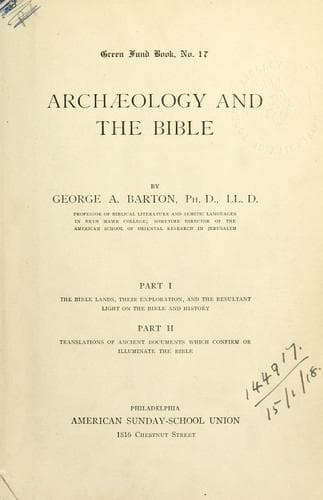
Archæology and the BibleBarton, George A. (George Aaron)
Religion
Archæology and the Bible
Barton, George A. (George Aaron)
Bible -- Antiquities; Egypt -- Antiquities; Middle East -- Antiquities
“Behold, thou shalt now abide with me;
Good is that which I shall do for thee.”
He put me at the head of his children,
He married me to his eldest daughter,
He made me select for myself of his land,
Of the choicest of that which he had,
On his boundary with another land.
It was a goodly land, named Yaa;[448]
There were figs in it and vines,
More plentiful than water was its wine,
Copious was its honey, plenteous its oil;
All fruits were upon its trees.
Barley was there and spelt,
Without end all cattle.
Moreover, great was that which came to me,
Which came for love of me,
When he appointed me sheik of the tribe,
From the choicest of his land.
I portioned the daily bread,
And wine for every day,
Cooked flesh and fowl in roast;
Besides the mid goats of the hills,
Which were trapped for me, and brought to me;
Besides that which my dogs captured for me.
There was much--made for me,
And milk in every sort of cooked dish.
I spent many years,
My children became strong,
Each the mighty man of his tribe.
The messenger going north,
Or passing southward to the court,
He turned in to me.
For I had all men turn in (to me).
The tale goes on concerning the personal prowess of Sinuhe, who, in his
old age, returned to Egypt and made his peace with the king.
=2. Communication between Egypt and Palestine.=
This document from the early patriarchal age reveals a close relationship
between Egypt and Palestine. There was frequent communication between
Kedem and Egypt; messengers went to and fro. The Egyptian language was
understood at the court of the Amorite chieftain. These conditions throw
light on the narratives of the descent of Abraham and Jacob to Egypt.
Sinuhe’s description of his life necessarily reminds one of the
description of Palestine so often met with in the Pentateuch, Joshua, and
the prophets, “a land flowing with milk and honey.” (See, for example,
Exod. 3:8, 17.)
(_For an addition to this chapter, see Appendix._)
CHAPTER XII
MOSES AND THE EXODUS
THE LEGEND OF SARGON OF AGADE; ITS RESEMBLANCE TO THE STORY OF MOSES.
THE PILLAR OF MERNEPTAH; THE ONLY APPEARANCE OF THE NAME “ISRAEL”
OUTSIDE OF THE BIBLE.
=1. The Legend of Sargon of Agade.=
The following legend[449] contains a story of the exposure of an infant on
a river, strikingly like that told of Moses.
1. Sargon, the mighty king, king of Agade am I,
2. My mother was lowly; my father I did not know;[450]
3. The brother of my father dwelt in the mountain.
4. My city is Azupiranu, which is situated on the bank of the
Euphrates.
5. My lowly mother conceived me, in secret she brought me forth.
6. She placed me in a basket of reeds, she closed my entrance with
bitumen,
7. She cast me upon the river, which did not overflow me.
8. The river carried me, it brought me to Akki, the irrigator.
Public-domain text, read in full here on John Shaqi.
Reviews
Reviews
No reviews yet
Be the first to share your thoughts on this work.
Elsewhere in the archive
Join the Discussion
Join the discussion
Sign in to leave a comment or review.
Sign InorCreate an account