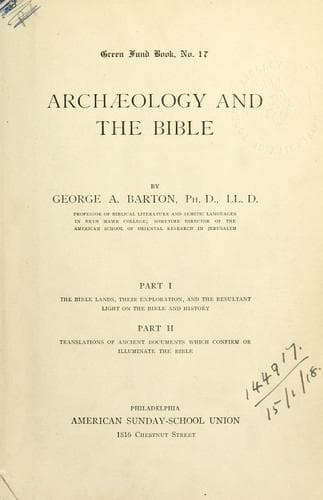
Archæology and the BibleBarton, George A. (George Aaron)
Religion
Archæology and the Bible
Barton, George A. (George Aaron)
Bible -- Antiquities; Egypt -- Antiquities; Middle East -- Antiquities
These laws are strikingly parallel to Exod. 21:18-27, to which Exod.
21:12-14 should be prefixed. The Babylonian code, like the Hebrew, imposes
the death penalty for wilful murder. Both codes provide that one who is an
accidental homicide shall escape the penalty, but they do it in different
ways. Hammurapi provides that the killer may take an oath that he did it
without intent to kill. Exod. 21:13, 14 provides that the homicide may
find sanctuary at the altar of God. In place of this Deut. 19:4, ff.,
provides that he may flee to a city of refuge.
If a man injures another in a fight, the Bible (Exod. 21:18, 19) provides
that he shall pay for the lost time and, as does Hammurapi, the cost of
healing the injured man. Exod. 21:22 provides, as does Hammurapi, for the
payment of a fine for causing a woman to miscarry, but Exodus does not,
like the Babylonian code, fix the amount of the damage; that is left to
the judges. In the laws concerning the injury of slaves the two codes
differ. Exodus provides (21:20, 21, 26, 27) for cases in which owners
injure or kill their own slaves; Hammurapi, for cases in which the injury
is done by others. A mere reading of the penalties imposed by the parts of
the Babylonian code translated above impresses vividly upon the mind the
fact that underlying many of them is the principle so forcibly expressed
in Exod. 21:21-25: “life for life, eye for eye, tooth for tooth, hand for
hand, foot for foot, burning for burning, wound for wound, stripe for
stripe.” The details of application are different, but the principle is
the same. Many of the differences were caused by the more complex nature
of Babylonian society, in which three classes, patricians, workingmen (or
semi-serfs), and slaves, existed. Hebrew law recognizes but two
classes--freemen and slaves.
Physicians
§ 215. If a physician operates upon a man for a severe wound with a
bronze lancet and saves the man’s life, or if he operates for cataract
with a bronze lancet and saves the man’s eye, he shall receive 10
shekels of silver.
§ 216. If it is a workingman, he shall receive 5 shekels of silver.
§ 217. If it is a man’s slave, the owner of the slave shall give the
physician 2 shekels of silver.
§ 218. If a physician operates upon a man with a bronze lancet for a
severe wound, and the man dies; or operates upon a man with a bronze
lancet for cataract and the man’s eye is destroyed, they shall cut off
his hand.
§ 219. If a physician operates with a bronze lancet upon the slave of
a workingman and causes his death, he shall restore a slave of equal
value.
§ 220. If he operates for cataract with a bronze lancet and destroys
his eye, he shall pay ½ his price.
§ 221. If a physician sets a broken bone for a man or has cured of
sickness inflamed flesh, the patient shall pay 5 shekels of silver to
the physician.
§ 222. If he is a workingman, he shall give 3 shekels of silver.
Public-domain text, read in full here on John Shaqi.
Reviews
Reviews
No reviews yet
Be the first to share your thoughts on this work.
Elsewhere in the archive
Join the Discussion
Join the discussion
Sign in to leave a comment or review.
Sign InorCreate an account