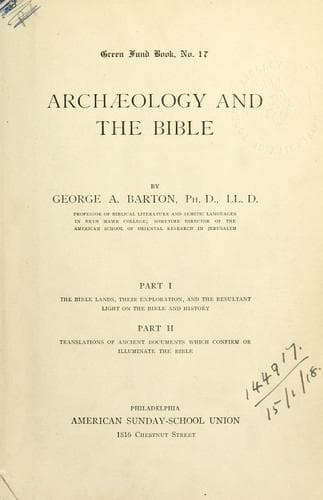
Archæology and the BibleBarton, George A. (George Aaron)
Religion
Archæology and the Bible
Barton, George A. (George Aaron)
Bible -- Antiquities; Egypt -- Antiquities; Middle East -- Antiquities
§ 259. If a man steals a watering-machine from a field, he shall pay
to the owner of the watering-machine 5 shekels of silver.
§ 260. If a man steals a watering-bucket or a plow, he shall pay 3
shekels of silver.
As the Hebrews did not systematically irrigate their land, the Old
Testament contains no similar laws.
Laws Concerning Shepherds
§ 261. If a man hires a herdsman to tend cattle or sheep, he shall pay
him 8 _Gur_ of grain per year.
§ 262. If a man, oxen, or sheep ..............
(The rest is broken away.)
§ 263. If he loses an ox or a sheep that is intrusted to him, he shall
restore ox for ox and sheep for sheep.
§ 264. If a herdsman who has had cattle or sheep intrusted to him
receives his full pay and is satisfied, and he causes the cattle or
the sheep to diminish in number or lessens the birth-rate, he shall
give increase and produce according to his contracts.
§ 265. If a shepherd to whom cattle or sheep have been given to tend
is dishonest and alters the price or sells them, they shall prosecute
him, and he shall restore to their owner 10 times the oxen or sheep
which he stole.
§ 266. If in a fold there is a pestilence of a god, or a lion has
slain, the shepherd shall before a god declare himself innocent, and
the owner of the fold shall bear the loss of the fold.
§ 267. If the shepherd is careless and causes a loss in the fold, the
shepherd shall make good in cattle or sheep the loss which he caused
in the fold and shall give them to the owner.
The nearest approach in the Old Testament to laws of this character is in
Exod. 22:10-13, which provides that, if a man deliver to his neighbor an
ox, or ass, or sheep, or any beast to keep, and it dies, or is injured or
is carried off when no one sees the deed, the oath of Jehovah shall be
between them that the keeper has not put his hand to his neighbor’s goods.
The owner was to accept this, and no restitution was necessary. If the
animals were stolen from the keeper, he must make restitution. If they
were torn in pieces by beasts of prey, he must bring the pieces for
witness, and need not make restitution.
The same general principles of the limits of responsibility underlay the
two codes in these cases, though they differ in details. In Israel the
shepherding of the flocks and herds of other people was not, as in
Babylonia, a distinct occupation.
On Wages of Animals and Men
§ 268. If a man hires an ox for threshing, 20 _Qa_ of grain is its
hire.
§ 269. If he hires an ass for threshing, 10 _Qa_ of grain is its hire.
§ 270. If he hires a kid for threshing, 1 _Qa_ of grain is its hire.
§ 271. If he hires cattle, a wagon and a driver, he shall pay 180 _Qa_
of grain per day.
§ 272. If a man hires a wagon only, he shall pay 40 _Qa_ of grain per
day.
Public-domain text, read in full here on John Shaqi.
Reviews
Reviews
No reviews yet
Be the first to share your thoughts on this work.
Elsewhere in the archive
Join the Discussion
Join the discussion
Sign in to leave a comment or review.
Sign InorCreate an account