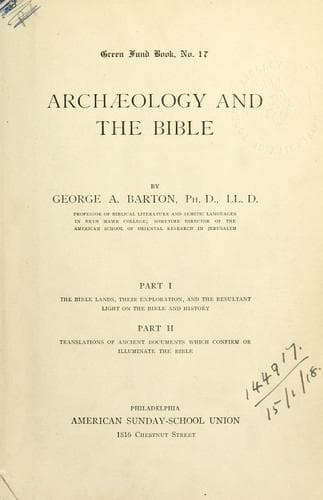
Archæology and the BibleBarton, George A. (George Aaron)
Religion
Archæology and the Bible
Barton, George A. (George Aaron)
Bible -- Antiquities; Egypt -- Antiquities; Middle East -- Antiquities
This penalty reminds one of the boring of a slave’s ear (Exod. 21:6; Deut.
15:17) in token of perpetual slavery.
=2. The Mosaic Code not Borrowed from the Babylonian; Different Underlying
Conceptions.=
A comparison of the code of Hammurapi as a whole with the Pentateuchal
laws as a whole, while it reveals certain similarities, convinces the
student that the laws of the Old Testament are in no essential way
dependent upon the Babylonian laws. Such resemblances as there are arose,
it seems clear, from a similarity of antecedents and of general
intellectual outlook; the striking differences show that there was no
direct borrowing. The primitive Semitic custom of an eye for an eye and a
tooth for a tooth (Exod. 21:24; Lev. 24:20; Deut. 19:21) is made the basis
of many penalties in the Babylonian code. (See §§ 196, 197, 200, 229, 230,
etc.) The principle underlying it is found also in many other sections.
These similarities only show that Babylonia had a large Semitic element in
its population. Again, Hammurapi pictured himself at the top of the pillar
on which these laws are written as receiving them from the sun-god (Fig.
292). The Bible tells us that Moses received the laws of the Pentateuch
from Jehovah. The whole attitude of the two documents is, however,
different. Hammurapi, in spite of the picture, takes credit, both in the
prologue and in the epilogue of his code, for the laws. He, not Shamash,
established justice in the land. Moses, on the other hand, was only the
instrument; the legislation stands as that of Jehovah himself.
This difference appears also in the contents of the two codes. The
Pentateuch contains many ritual regulations and purely religious laws,
while the code of Hammurapi is purely civil. As has been already pointed
out, the code of Hammurapi is adapted to the land of the rivers, and to a
highly civilized commercial people, while the Biblical laws are intended
for a dry land like Palestine, and for an agricultural community that was
at a far less advanced stage of commercial and social development.
Religion is, however, not a matter of social advancement only. In all that
pertains to religious insight the Pentateuch is far in advance of
Hammurapi’s laws.
CHAPTER XIV
AN ALLEGED PARALLEL TO LEVITICUS--A CARTHAGINIAN LAW CONCERNING
SACRIFICES[469]
THE TEXT OF THE CARTHAGINIAN LAW. COMPARISON WITH THE LEVITICAL LAW.
=1. The Text of the Carthaginian Law.=
Temple of Baal[zephon], Tar[iff of d]ues, which [the superintendents
of d]ues fixed in the time [of our rulers, Khalas]baal, the judge, son
of Bodtanith, son of Bod[eshmun, and of Khalasbaal], the judge, son of
Bodeshmun, son of Khalasbaal, and their colleagues.
Public-domain text, read in full here on John Shaqi.
Reviews
Reviews
No reviews yet
Be the first to share your thoughts on this work.
Elsewhere in the archive
Join the Discussion
Join the discussion
Sign in to leave a comment or review.
Sign InorCreate an account