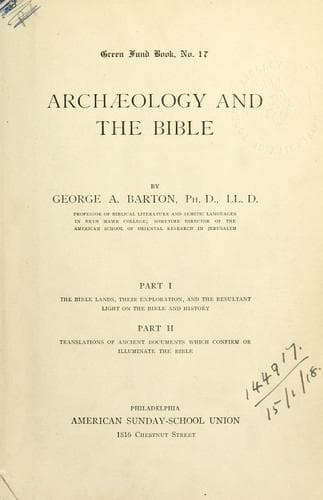
Archæology and the BibleBarton, George A. (George Aaron)
Religion
Archæology and the Bible
Barton, George A. (George Aaron)
Bible -- Antiquities; Egypt -- Antiquities; Middle East -- Antiquities
The writer is inclined to hold that the Habiri were Hebrews, though this
view is not without difficulty. The indications of the book of Exodus
point to Ramses II as the Pharaoh of the oppression and to Merneptah as
the Pharaoh of the Exodus. These kings belonged to the nineteenth dynasty,
while Amenophis IV, to whom Ebed-Hepa wrote his letters, belonged to the
eighteenth. How then could Hebrews be already in Palestine struggling to
conquer it? The view has been held by a number of scholars that the Hebrew
conquest took place in two parts, one of which was under the eighteenth
and the other under the nineteenth dynasty. The view is not without its
difficulties, but it _may_ prove to be true. If the Habiri were Hebrews,
it seems necessary to suppose that it is true. Perhaps further discovery
will throw more light upon it.
The following letter, found in 1892 at Tell el-Hesy (Lachish) in
Palestine, belongs to the same period as the preceding letters.[487]
To the chief officer speak, saying: Pabi--at thy feet I prostrate
myself. Thou shouldst know that Shiptibaal and Zimrida are conspiring
together and Shiptibaal has said to Zimrida: “My father of the city
Yarami has written to me: ‘Give me six bows and three daggers and
three swords. If I go out against the land of the king and thou wilt
be the breath of life to me, then I shall surely (?) be superior to it
and shall subdue it.’ He who makes this plan is Pabu, so send him to
me.” Now I have sent thee Raphiel. He will bring to the chief officer
news of this matter.
Another letter from Taanach belongs to the same general period. It is one
of four found by Sellin in 1903. It is as follows:[488]
To Ishtarwashur speak, saying, Ahijah[489]--may the lord of the gods
protect thy life! Thou art my brother and love is in thy bowels and in
my heart. When I was detained in Gurra a workman gave to me two knives
and a lance and two baskets (?) for nothing. As the lance was broken,
he will repair it and send it by the hand of Buritpi. Again: is there
lamentation over thy cities, or hast thou indeed put thyself in
possession of them? Over my head is one who is over the cities. Now
let us see whether he will do good to thee. If his countenance is
favorable there will be great destruction. Further: let Ilurabi enter
Rahab and either send my man to thy presence or give him protection.
This letter is chiefly interesting for the name _Aḫi-ya-mi_, which is
probably the Babylonian equivalent of Ahijah or Ahi-Yahweh. If this is so,
and, while not certain, there is considerable collateral evidence in its
favor,[490] the divine name, Yahweh (Jehovah), was already known in
Palestine.
Public-domain text, read in full here on John Shaqi.
Reviews
Reviews
No reviews yet
Be the first to share your thoughts on this work.
Elsewhere in the archive
Join the Discussion
Join the discussion
Sign in to leave a comment or review.
Sign InorCreate an account