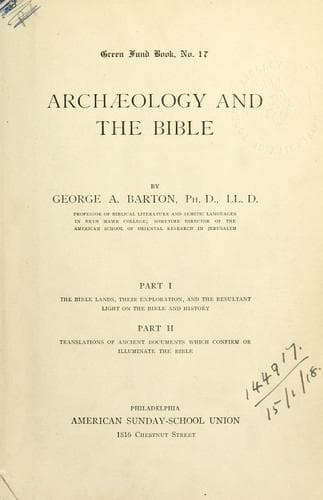
Archæology and the BibleBarton, George A. (George Aaron)
Religion
Archæology and the Bible
Barton, George A. (George Aaron)
Bible -- Antiquities; Egypt -- Antiquities; Middle East -- Antiquities
(7) _The Persian Period_ lasted from 538 to 331 B. C. During this time
Babylonia was but a province of the Persian empire, though the Persian
kings made it one of their capitals. Cyrus reversed the policy of
transportation, which had been practised by the Assyrians and Babylonians
for two hundred years, and permitted subject peoples to return to their
lands and restore their institutions and worship. He sought to attach them
to his government by gratitude instead of fear. It was owing to this
policy that the Jewish state was once more established with Jerusalem as
its capital, though still a Persian colony. Cambyses extended Persian
power to Egypt in 525, and Darius I, 521-485 B. C., extended it to India
and into Europe. Under Darius the temple at Jerusalem was rebuilt and the
Jews there tried unsuccessfully to regain their independence. This they
attempted once more under Artaxerxes III about 350 B. C., but his general,
Bagoses, put down their rebellion with great severity. During the Persian
period life in Babylonia went on as before. The old gods were worshiped,
the old culture was continued, the same language was used, and many
business documents written in it have come down to us. The earlier Persian
kings employed it for their inscriptions, and in a short time the Persians
made from it an alphabet of their own.
(8) _The Greek and Parthian Periods._--Alexander the Great overthrew
Darius III, the last of the Persian kings, in 331 B. C., when Assyria and
Babylonia passed under the sway of the Macedonian. When Alexander returned
from his conquest of hither India in 325 B. C., he planned to extend his
empire westward to the Atlantic Ocean, and to make Babylon its capital.
Plans for the enlargement and beautifying of the city, so as to make it a
worthy capital for such an empire, were under way when Alexander suddenly
died in June, 323 B. C. In the final division of the world among
Alexander’s successors, Babylonia fell to Seleucus, together with all the
territory from the Mediterranean to the borders of India. As Seleucus
desired a capital on the Mediterranean, so as to watch more successfully
the movements of his rivals, he built Antioch on the Orontes and made it
his residence. Babylon was, however, made the capital of the eastern half
of the empire, and the king’s son, as viceroy, made it his residence.
Public-domain text, read in full here on John Shaqi.
Reviews
Reviews
No reviews yet
Be the first to share your thoughts on this work.
Join the Discussion
Join the discussion
Sign in to leave a comment or review.
Sign InorCreate an account