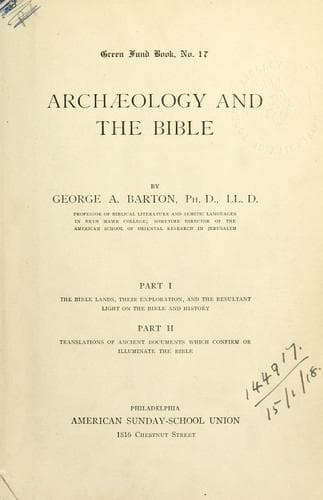
Archæology and the BibleBarton, George A. (George Aaron)
Religion
Archæology and the Bible
Barton, George A. (George Aaron)
Bible -- Antiquities; Egypt -- Antiquities; Middle East -- Antiquities
Soon after 260 B. C. Bactria and Parthia, in the eastern part of the
empire of the Seleucidæ, gained their independence. In course of time
Parthia absorbed Bactria and became an empire, which lasted till 230 A. D.
About 150 B. C. the Parthians conquered Babylonia, which remained with
little interruption under their sway till the establishment of the
Sassanian kingdom of the Persians in 220 A. D. Babylonia was under the
control of this last dynasty until the coming of the Mohammedans in the
year 637 A. D. The old culture of the Babylonians, their religion,
language, and writing were maintained well down toward the Christian era.
Copies of old Sumerian hymns have been found in Babylonia which bear dates
as late as 81 B. C., and business documents in Semitic are numerous.[17]
=7. Discoveries Which Illumine the Bible.=--Discoveries in Babylonia and
Assyria which illumine the Biblical narratives are numerous. The sites of
many cities, such as Ur of the Chaldees, Erech, Babylon, Ashur, Nineveh,
and Calah, have been excavated. The number of documents which have come to
light which in one way or another have a bearing on the Bible is too
numerous to mention here. An effort has been made in Part II to translate
examples of most of them. Indeed, the greater part of the material in Part
II was recovered by excavations in these countries.
To Babylonia and to Egypt mankind owes the working out of the initial
problems of civilization, the processes of agriculture, the making of
bricks, the working of stone, the manufacture and use of the ordinary
implements of life, the development of elementary mathematics and
astronomy, etc. These problems were by slow processes independently worked
out in each country through long ages. The higher spiritual concepts which
have now become the heritage of man neither Babylonia nor Egypt was fitted
to contribute. These came through the agency of other peoples.
CHAPTER III
THE HITTITES
A FORGOTTEN EMPIRE. HITTITE MONUMENTS: Sendjirli. Boghaz Koi. Other
recent excavations. HITTITE DECIPHERMENT: Sayce’s early work. Peiser.
Jensen. Conder. Sayce’s later work. Thompson. Delitzsch. HITTITE
HISTORY: First appearance. Hyksos possibly Hittites. The Mitanni.
Kingdom of “Hittite City.” Carchemish. Samal and Yadi. Hamath.
Public-domain text, read in full here on John Shaqi.
Reviews
Reviews
No reviews yet
Be the first to share your thoughts on this work.
Elsewhere in the archive
Join the Discussion
Join the discussion
Sign in to leave a comment or review.
Sign InorCreate an account