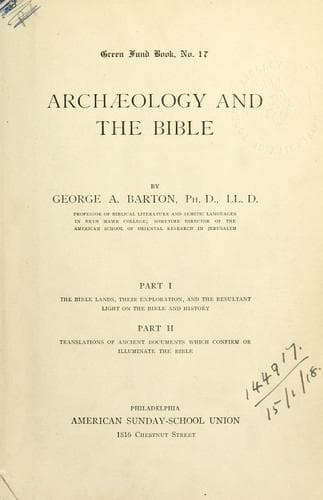
Archæology and the BibleBarton, George A. (George Aaron)
Religion
Archæology and the Bible
Barton, George A. (George Aaron)
Bible -- Antiquities; Egypt -- Antiquities; Middle East -- Antiquities
Meanwhile the great kingdom of the Hittites at Boghaz Koi had entered upon
its era of expansion under Subbiluliuma, who pushed his conquests first
eastward and then southward. Dushratta feared to meet the Hittite in
battle and retired to the eastward, allowing much of his country to be
overrun. This land Subbiluliuma gave to one of his allies, and Dushratta
was murdered soon afterward by his son, Sutatarra, who usurped the crown.
Soon after this the Assyrians invaded the lands of the Mitanni from the
east, and the land, already distracted by its internal divisions, was
thrown into a worse confusion. At this juncture Subbiluliuma crossed the
Euphrates again and entered Mitannian territory. He was accompanied by
settlers who brought cattle, sheep, and horses to remain in the country.
Advised by an oracle, he deposed Sutatarra and placed upon the throne
Mattiuaza, a son of Dushratta, who had been heir-apparent and who had fled
when his father was murdered. To Mattiuaza Subbiluliuma gave his daughter
in marriage, and Mitanni became a vassal state of the Hittite realm. After
this our sources tell us no more of its history.
Near the Mitanni were the Harri, who were probably of the same race, for
in the time of Subbiluliuma they were ruled first by Artatama II, a
brother of Dushratta, and then by Sutarna II. This state also became a
part of Subbiluliuma’s kingdom.
(4) _Kingdom of “Hittite City.”_--The wave of migration from the northeast
which brought the Mitanni into upper Mesopotamia had swept on westward
into Cappadocia, where the greatest Hittite state afterward developed. The
monuments erected by the Hittites were nearly all of a religious
character. In the earlier time they wrote few historical inscriptions.
Such inscriptions as we have in Hittite hieroglyphs seem to come from the
later periods and to record alliances. It is probable that in the
development of the Hittite state in Cappadocia first one city and then
another had the upper hand. The Hittite monuments at Eyuk are of a more
primitive character than those at Boghaz Koi, and it is natural to suppose
that a Hittite state flourished here before the rise of the one at Boghaz
Koi. Be that as it may, the most powerful Hittite monarchy of which we
know arose at Boghaz Koi, which they called “Hittite City.” This monarchy
emerged about 1400 B. C. Its first king was Hattusil I, of whom we know no
more than that he was the founder of the great dynasty which ruled from
the “Hittite City” for two hundred years.
Public-domain text, read in full here on John Shaqi.
Reviews
Reviews
No reviews yet
Be the first to share your thoughts on this work.
Elsewhere in the archive
Join the Discussion
Join the discussion
Sign in to leave a comment or review.
Sign InorCreate an account