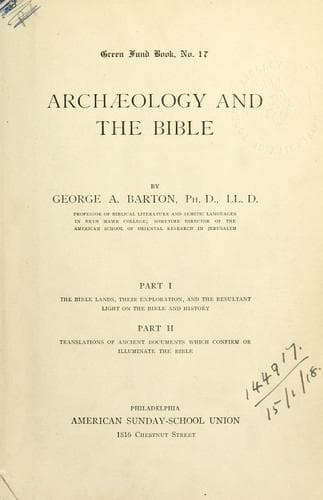
Archæology and the BibleBarton, George A. (George Aaron)
Religion
Archæology and the Bible
Barton, George A. (George Aaron)
Bible -- Antiquities; Egypt -- Antiquities; Middle East -- Antiquities
This city was destroyed by a siege which resulted in the burning of the
city--a burning which left quite a bed of ashes. Dr. Mackenzie thought
that this was the siege by which the Israelites gained possession of
Beth-shemesh. The city was occupied by the Hebrews apparently until the
invasion of Palestine by Sennacherib, King of Assyria, in 701 B. C. At all
events, it was in the possession of Judah in the days of King Amaziah (2
Kings 14:8-14). Corresponding to this, Israelitish pottery was found in
the stratum above the ashes. Dr. Mackenzie is of the opinion that during
this Hebrew period the city was without a wall. Apparently after the time
of Sennacherib the site was abandoned for several centuries, for next
above the Israelitish stratum the remains of a monastery of the Byzantine
period (325-636 A. D.) were found. This monastery apparently was not begun
until just at the close of the Byzantine period, for it appears that it
was not finished at the time of the Mohammedan conquest.
(11) _Exploring the Wilderness of Zin._--The most recent service of the
Palestine Exploration Fund was the sending of two explorers, C. Leonard
Woolley and T. E. Lawrence, in the winter of 1913-14, to explore the
wilderness to the south of Palestine. The results of their work have been
published in the Fund’s _Annual_, Vol. III, under the title _The
Wilderness of Zin_. The explorers identified a considerable part of the
“Darb es-Shur,” or the “way of Shur” (Gen. 16:7, etc.). It was the caravan
road from Palestine to Egypt. They also adduce strong evidence against the
identification of Ain Kades with Kadesh-Barnea (Num. 32:8, etc.), and
think that Kossima, which lies nearer to the Egyptian road and is
surrounded by much more verdure, may have been Kadesh-Barnea. The
identification of Ain Kades with Kadesh-Barnea was made by the late Dr.
Henry Clay Trumbull, after a very brief visit to the spot, and it has been
accepted by many others.
Between 325 and 636 A. D. extensive settlements and cities of considerable
size existed in this wilderness. This was one of the facts that led
Ellsworth Huntington to believe that the rainfall in Palestine was much
greater at that time. With this view Woolley and Lawrence take issue. They
say that where the old wells have been kept open, the water still rises as
high as ever it did. They hold that the cities mentioned were possible
because of the great energy and skill of the people of that time in
sinking wells.
Public-domain text, read in full here on John Shaqi.
Reviews
Reviews
No reviews yet
Be the first to share your thoughts on this work.
Elsewhere in the archive
Join the Discussion
Join the discussion
Sign in to leave a comment or review.
Sign InorCreate an account