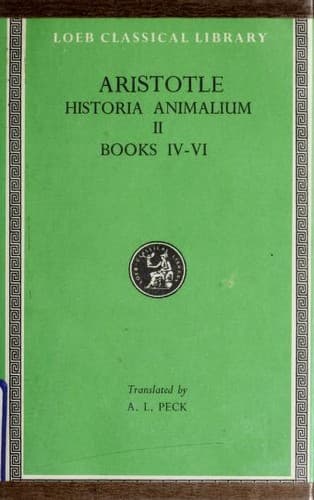
Aristotle's History of Animals: In Ten BooksAristotle
PhilosophyPhilosophy
Aristotle's History of Animals: In Ten Books
Aristotle
Zoology -- Pre-Linnaean works
1. The reproductive function is not active in all fish at the same time
or the same manner, nor are they pregnant during the same length of
time. Before the season of sexual intercourse the males and females
begin to assemble, and at the period of intercourse and the production
of their ova they pair together. Some of them do not remain pregnant
more than thirty days, and others not so long; but all of them remain
so for a number of days, which can be distributed into seven. Those
which some persons call marini remain pregnant for the longest period.
The sargus becomes pregnant in the month of December, and remains so
for thirty days. The kind of cestreus which some persons call the
chelon and the myxon are pregnant at the same time as the sargus. All
these suffer in their pregnancy, wherefore they are driven to the shore
at this season; for in the vehemence of their desire they are carried
towards the land, and always continue in motion during this period till
they have produced their ova. The cestreus is more remarkable for this
than any other fish. As soon as they have deposited their ova, they
become quiet.
2. In many fish there is a limit to their reproductive powers, when
worms make their appearance in their abdomen. These worms are small
living creatures, which expel the reproductive substance. The small
fry of the rhyas makes its appearance in the spring, and that of many
others about the vernal equinox. Other fish do not produce at this
season of the year, but in the summer or near the autumnal equinox.
3. The atherina produces its young first of all, near the land. The
cephalus is the last. This is evident from the small fry of the former
appearing first, and that of the latter last of all. The cestreus also
produces among the first. The salpa in most places deposits its ova
during the summer, and sometimes in the autumn. The aulopias, which
they call anthias, produces its ova in the summer season. After these
the chrysophrys, labrax, mormyrus, and all those which are called
dromades; the trigla and cocarinus are the latest of all the gregarious
fish. These oviposit in the autumn. The trigla deposits her ova in the
mud, which causes her to be late, for the mud continues cold for a long
while. The coracimus is next to the trigla, and goes among the sea
weed to deposit her ova: consequently they frequent rocky places. It
continues pregnant for a long while. The mænides oviposit at the winter
solstice. Many other marine fish oviposit in the summer, for they are
not captured at this period. The mænis is the most productive of all
fish, and the batrachus the most so among the selache. They are,
however, rare, for they perish very readily; they oviposit in shoals
and near the land.
Public-domain text, read in full here on John Shaqi.
Reviews
Reviews
No reviews yet
Be the first to share your thoughts on this work.
Elsewhere in the archive
Join the Discussion
Join the discussion
Sign in to leave a comment or review.
Sign InorCreate an account