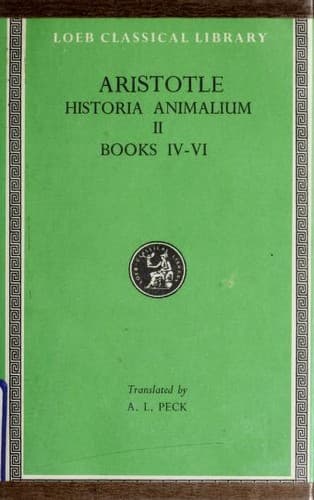
Aristotle's History of Animals: In Ten BooksAristotle
PhilosophyPhilosophy
Aristotle's History of Animals: In Ten Books
Aristotle
Zoology -- Pre-Linnaean works
2. If any of the pigs are injured or deteriorated during pregnancy, it
is called metachæron. This may take place in any part of the uterus. In
parturition the sow gives the first teat to the first pig. It is not
necessary that she should go to the boar as soon as the sexual appetite
is felt, or before her ears begin to hang down; for otherwise she
desires to go again. If she goes to the boar when she is desirous of
it, the impregnation is complete in a single act of intercourse. Barley
is a proper food for the boar at the period of coition. It should be
cooked for the female after parturition. Some sows produce excellent
pigs from the first; others do not produce good offspring and pigs till
they are grown up. Some persons say that if one of the eyes of a sow
is put out, she generally speaking dies very soon. Most of them live
fifteen. Some die in less than twenty years.
CHAPTER XIX.
1. Sheep become pregnant after three or four acts of sexual
intercourse. If rain falls after the act of intercourse, it must be
repeated. The nature of goats is the same. They generally produce two,
and sometimes three. Cases have occurred of their producing four. The
period of gestation in the sheep and goat is five months; and in some
places, where the weather is warm and fine, and food is abundant, they
have young twice a-year. The goat will live eight years. The sheep
lives ten years, or generally rather less; but the leaders of the flock
live fifteen years; for in every flock they select one of the males
as a leader, who, when called by the shepherd, places himself at the
head of the flock. They are accustomed to this duty even when young. In
Ethiopia the sheep live twelve or thirteen years, and the goats ten or
eleven.
2. Both the sheep and goat enjoy sexual intercourse as long as they
live. Sheep and goats produce twins, if either the pasture is good, or
the ram or he-goat, or the ewe belongs to a race producing twins. They
produce females or males both from the nature of the water (for there
are some waters that cause them to produce males and others females)
and from their manner of sexual intercourse; and if the wind is
northward during copulation they produce males; and if it is southward,
females; and one which naturally produces females will change its
nature and produce males; so that it is necessary to see that they
stand to the north during the act of sexual intercourse. If any are
accustomed to copulate early, and the ram is introduced to them late,
they will not endure it.
Public-domain text, read in full here on John Shaqi.
Reviews
Reviews
No reviews yet
Be the first to share your thoughts on this work.
Elsewhere in the archive
Join the Discussion
Join the discussion
Sign in to leave a comment or review.
Sign InorCreate an account