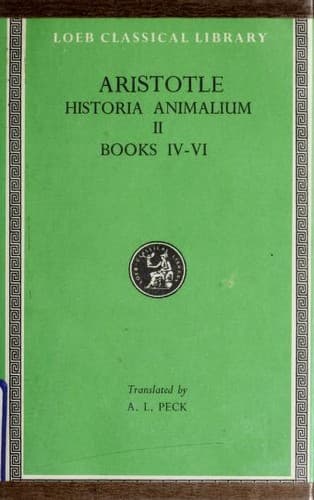
Aristotle's History of Animals: In Ten BooksAristotle
PhilosophyPhilosophy
Aristotle's History of Animals: In Ten Books
Aristotle
Zoology -- Pre-Linnaean works
3. Of all animals the most remarkable in this particular is the
dolphin, and some other aquatic animals and cetacea which are of this
habit, as the whale and others which have a blowhole; for it is not
easy to arrange them either with aquatic or terrestrial animals, if
we consider animals that breathe air as terrestrial, and those that
breathe water as aquatics, for they partake of the characters of
both classes; for they receive the sea and eject it through their
blowhole, and air through their lungs, for they have this part, and
breathe through it. And the dolphin, when captured in nets, is often
suffocated, from the impossibility of breathing. It will live for a
long while out of water, snoring and groaning like other breathing
animals. It sleeps with its snout above the water, in order that it may
breathe through it.
4. It is thus impossible to arrange it under both of these contrary
divisions, but it would appear that the aquatic animals must be further
subdivided; for they breathe and eject water for the same reason as
others breathe air, for the sake of coolness. Other animals do this
for the sake of food; for those animals which obtain their food in the
water, must also, at the same time, swallow some of the fluid, and have
an organ by which they can eject it. Those creatures which use water
instead of air for breathing have gills; those that use it for food
have a blowhole. These creatures are sanguineous. The nature of the
malacia and malacostraca is the same; for these swallow water for food.
5. Those animals which breathe air, but live in the water, and those
which breathe water, and have gills, but go out upon dry land and take
their food there, belong to two divisions of aquatic animals. This last
division is represented by a single animal called the cordylus (water
newt); for this animal has no lungs, but gills; and it goes on dry
land to procure its food. It has four feet, so that it appears natural
that it should walk. In all these animals nature appears to be, as it
were, turned aside, and some of the males appear to be females, and
the females have a male appearance; for animals which have but small
diversity in particular parts, exhibit great variations in the whole
body.
Public-domain text, read in full here on John Shaqi.
Reviews
Reviews
No reviews yet
Be the first to share your thoughts on this work.
Elsewhere in the archive
Join the Discussion
Join the discussion
Sign in to leave a comment or review.
Sign InorCreate an account