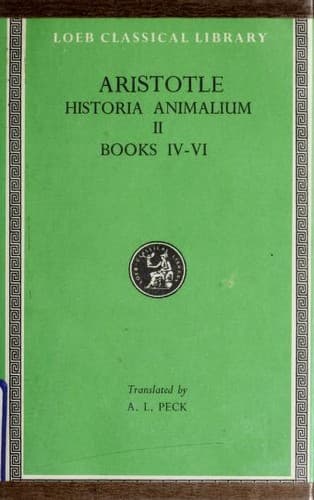
Aristotle's History of Animals: In Ten BooksAristotle
PhilosophyPhilosophy
Aristotle's History of Animals: In Ten Books
Aristotle
Zoology -- Pre-Linnaean works
9. The sepia is the most cunning of the malacia, and is the only one
which uses its ink for the purpose of concealment, when it is not
alarmed. The polypus and teuthis emit their ink only when alarmed.
These creatures never emit all their ink, and as soon as it is emitted
it is secreted again. But the sepia, as it has already been remarked,
makes use of its ink for the purposes of concealment, and when it
pretends to advance, it returns into its ink. With its long extended
tentacula it not only pursues small fish, but frequently attacks the
cestreus. The polypus is a foolish creature, for it will approach a
man's hand if brought near it. It is an economical animal, for it
collects all its prey in the hole in which it dwells, and when the most
useful part has been consumed, it ejects the shells, the coverings of
the cancri, and conchylia, and the spines of the fish, it pursues any
fish that may come in its way, changing its colour and imitating that
of any neighbouring stone. It does the same thing when alarmed.
10. Some persons say that the sepia has power to do the same thing,
and that it can imitate the colour of the place it inhabits. The rhine
is the only fish endowed with the same power, for it can change its
colours like the polypus. The polypus rarely lives for two years,
for it is by nature subject to decay. This is a proof of it, that
when pressed, this animal always emits something, until at last it
consumes away. The females suffer so much from this in the period of
parturition, as to become foolish, and not perceive any agitation of
the waves, so that they are easily taken by the hand of the diver; they
become like mucus, and are not able to pursue their prey.
11. The males become hard and shining. This appears to be a proof
that they do not survive a year, that in the summer and autumn, after
the production of the young, it is difficult to find a large polypus,
though large ones were abundant a short time before; when they have
produced their ova, they say that both sexes grow old and become so
weak, that they are devoured by small fish, and are easily dragged out
of their holes, though before they would have permitted nothing of the
kind. They also say that the small and young ones will not endure this,
and that they are stronger than the large ones. The sepia also only
lives one year; the polypus is the only one of the malacia that ever
ventures upon dry land, it advances upon a rough surface, but avoids
smooth places. In other respects, it is a strong animal, but its neck,
if pressed, becomes very weak.
Public-domain text, read in full here on John Shaqi.
Reviews
Reviews
No reviews yet
Be the first to share your thoughts on this work.
Elsewhere in the archive
Join the Discussion
Join the discussion
Sign in to leave a comment or review.
Sign InorCreate an account