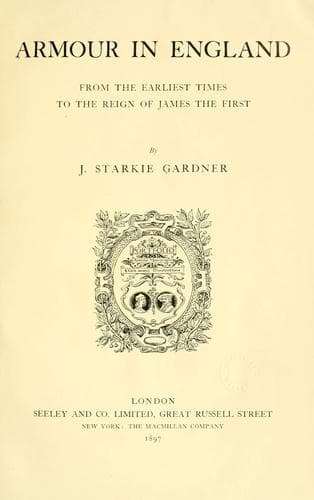
Armour in England, from the Earliest Times to the Reign of James the FirstGardner, John Starkie
History
Armour in England, from the Earliest Times to the Reign of James the First
Gardner, John Starkie
Armor -- England
the temptation natural to the survivor to retain the finely tempered
weapons and armour, whose quality had been tested in the field, had
always to be reckoned with. This reluctance to sacrifice them is
beautifully expressed in such ancient ballads as those on the death of
King Arthur.
Armour was moreover specially devised by will to be kept as heirlooms.
Grose in the _Antiquities_ states that Thomas Beauchamp, Earl of
Warwick in the time of Henry IV., left to his son Richard by will the
sword and coat of mail said to belong to the celebrated Guy, Earl of
Warwick, he having received them as an heir-loom from his father. Sir
Thomas Poynings, in 1369, devised to his heir the helmet and armour
which his father devised to him. It also became penal to make away with
armour. Enactments, such as that of 1270, commanded that all armour was
to be viewed and kept in safe keeping under good security not to be
let go, for the king's use at reasonable valuation. The custom, which
prevailed extensively, of leaving the undertaker to provide property
helmets and arms in place of those the departed had himself used, also
tended to lessen the interest of even the arms which yet remain. That
the helmet of Henry V. was provided by the undertaker is well known,
and that he continued to provide arms down to Elizabeth's time, is
shown by accounts of funerals such as of Lord Grey de Wilton in 1562,
when among the items of the undertaker's bill are a "cote of arms,"
banner and bannerolles, a "helmett of stele gylt with fyne golde,"
with a crest gilt and coloured, a "swerde with the hyltes, pomell,
chape, buckle, and pendant, likewise gylte, with a gurdle and sheathe
of velvet." This custom of substituting spurious insignia at the
solemn interment of the dead was set by the Church, who consigned mock
croziers and chalices of no intrinsic value to the graves of even the
most exalted prelates. But of the true and the spurious armour alike,
time, rust, and above all, changes of religious sentiment in regard
to the churches, have spared little besides an occasional helmet. The
claims of neighbouring magnates, to the custody of what they regard
as family relics, the temptation to sell, and lack of interest, have
further sadly reduced this residue within the present century.
Yet neglect and depredations notwithstanding, the preservation of
nearly all the English fighting helms known, from the time of the
Black Prince to that of Henry VIII., and of many swords of early date,
is due to their having been deposited in churches. Other magnificent
fourteenth and even thirteenth century swords owe their preservation
to their inclusion in the insignia of Municipal Corporations. Lincoln,
Bristol, Kingston on Hull, Newcastle-on-Tyne, Southampton, Gloucester,
Hereford, Exeter, Chester, Coventry, are among the cities still
possessing these interesting relics.
Public-domain text, read in full here on John Shaqi.
Reviews
Reviews
No reviews yet
Be the first to share your thoughts on this work.
Elsewhere in the archive
Join the Discussion
Join the discussion
Sign in to leave a comment or review.
Sign InorCreate an account