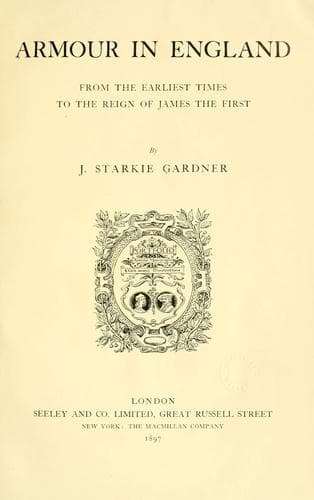
Armour in England, from the Earliest Times to the Reign of James the FirstGardner, John Starkie
History
Armour in England, from the Earliest Times to the Reign of James the First
Gardner, John Starkie
Armor -- England
It is unfortunate that nearly all the notable private collections made
within the present century have been dispersed, either on the death of
their owners, or before. The Walpole, Bernal, Meyrick, Londesborough,
Shrewsbury, Coutts-Lindsay, Brett, De Cosson, and many other
collections have been scattered far and wide under the hammer. The
Warwick and others have suffered severely by fire; and of collections
made by the past generation probably only that of Lord Zouche at Parham
remains intact.
A great deal of armour is absorbed as decoration, not only in such
stately homes of the nobility as Arundel, Eaton Hall, Hatfield,
Knebworth, but in private houses. Armour is also hidden away in small
and unknown collections, like two in the writer's family, which would
well repay careful examination. But undoubtedly the richest treasures
are in the collections of wealthy amateurs, like Mr. David Currie, Sir
Noël Paton, and above all in those of members of the Kernoozer's Club.
It is impossible to convey, in a slight sketch, any adequate idea of
the wealth of armour in the country, the real extent of which is as yet
only to be surmised; but in spite of sales it is doubtless increasing
yearly.
The fact cannot be ignored that, of all this mass of armour, very
little has been made in England. By far the larger part was indeed
certainly made in Germany, a country devoted to metal-working from the
earliest periods of its history.
The first dawning of anything like European reputation for the
production of arms and armour, since the collapse of the Roman Empire,
was achieved by Germany. Owing to its political constitution, and
perhaps extent and population, its towns were more enterprising
in mediæval ages than ours, and acquired a name for particular
manufactures at a relatively early period. The necessity the trading
towns were under of arming their citizens to defend their freedom and
privileges, amidst the semi-independent princelings and nobles who kept
armed retainers and combined to levy blackmail, induced many to take
up the manufacture of arms in self-defence, for which they afterwards
sought a market among neighbours and abroad. In the thirteenth century,
when St. Louis bore a German sword to the Crusades, the names of
Cologne, Passau, Heilbronn appear almost simultaneously as seats
famous for the production of lethal weapons. Cologne soon assumed the
ascendency, at least in English eyes, for its weapons are spoken of
with respect in many an early ballad. Thus the battle of Otterbourne is
fought "with swords of fyne Collayne," and King Arthur's sword hails
from Cologne:--
For all of Coleyne was the blayde
And all the hilte of precious stone.
Public-domain text, read in full here on John Shaqi.
Reviews
Reviews
No reviews yet
Be the first to share your thoughts on this work.
Elsewhere in the archive
Join the Discussion
Join the discussion
Sign in to leave a comment or review.
Sign InorCreate an account