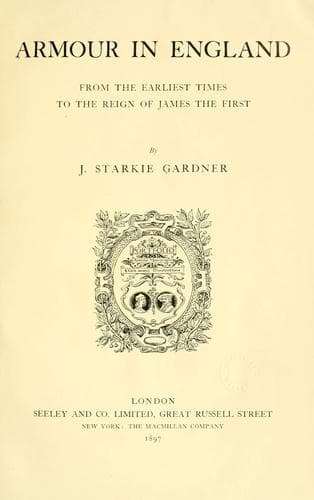
Armour in England, from the Earliest Times to the Reign of James the FirstGardner, John Starkie
History
Armour in England, from the Earliest Times to the Reign of James the First
Gardner, John Starkie
Armor -- England
Italy vied with Germany in the production of armour, Milan taking the
lead. Matthew of Paris heard, in 1237, from a credible Italian that
Milan and its dependencies could turn out 6000 men on iron-clad horses.
An item in the inventory of Louis Hutin, 1316, is "2 haubergeons de
Lombardi"; and that of Humphrey de Bohun, in 1322, mentions Bologna "un
haubergeon qu'est apele Bolioun." Italian armourers were established in
Paris as early as 1332. Ancient British ballads abound in references
to Myllan and Myllen steel. The Earl of Derby, afterwards Henry IV.,
sent to procure armour from Sir Galeas, Duke of Milan, and when he had
selected all he wished for in plated and mail armour, the Lord of Milan
ordered four of the best armourers in Milan to accompany the knight to
England. In the fifteenth century Milan was able, after the battle of
Macado in 1427, to furnish within a few days 4000 suits of armour for
cavalry and 2000 for infantry. At a great Spanish tournament held in
1434, only Italian armour and weapons were permitted. Louis XI. and
the Duke of Burgundy settled Italian armourers in their dominions.
This king seized in 1481 a heavy convoy of cuirasses, sallads, etc.,
packed in cotton to prevent them rattling and imitating bales of silk,
on the way to the Duke of Brittany, giving them to John Doyac as a
reward for their discovery. Monstrelet mentions that the Milanese gave
corselets and other armour to the Swiss, with the finest promises,
before the battle of Marignano. Henry VIII. kept 1000 Myllen swords
for the tourney in the Tower, and sent to Milan to purchase 5000 suits
of "almain rivets." The most eloquent testimony to the excellence of
Milanese arms is, however, to be found in the pages of Brantôme, a
very keen observer on all matters military. Milan furnished the finest
engraved and most elegant corselets for _hommes de pieds_ "tant de
M. de Strozzi que de Brissac." "Ce genre de cuirasse legère eut la
plus grande vogue à la cour de France"; and "on y approuvoit fort
les corselets gravés de Milan et ne trouvoit point que nos armoriers
parvinssent à la mesme perfection, non plus qu'aux morions." Strozzi,
insisting that his armaments should be Milanese, "pria voire quasy
contraignit tous ses capitaines de n'avoir plus autres armes, tant
harquebuses, fourniments, que corselets de Milan": while Guise wished
his infantry to be armed not with muskets, but good harquebuzes de
Milan--"de bonne trampe pour ne crever." Milanese armourers, like the
Gambertis, were enticed to Paris; Pompée a Milanese was selected to
teach the King fencing, and Maistre Gaspar de Milan is pronounced "le
meilleur forgeur qui jamais eut." Brantôme further describes the troops
on their way to relieve Malta, "portant sa belle harquebuze et son beau
fourniment de Milan," and adds, "car nous avions passé par Milan, où
nous nous estions accommodez d'habillements et d'armes si superbement
qu'on ne scavait pour quelz nous prendre, ou pour gentilshommes,
Public-domain text, read in full here on John Shaqi.
Reviews
Reviews
No reviews yet
Be the first to share your thoughts on this work.
Elsewhere in the archive
Join the Discussion
Join the discussion
Sign in to leave a comment or review.
Sign InorCreate an account