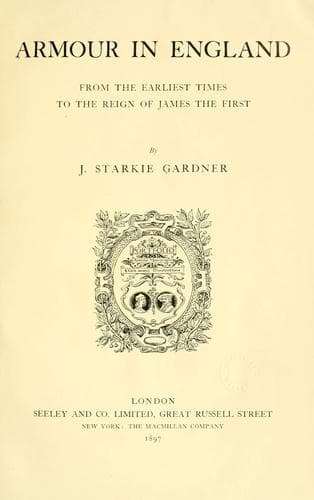
Armour in England, from the Earliest Times to the Reign of James the FirstGardner, John Starkie
History
Armour in England, from the Earliest Times to the Reign of James the First
Gardner, John Starkie
Armor -- England
France is very much in the same position as England in regard to
armour, for no city in it ever established any permanent reputation as
a seat of manufacture. Louis X. had a Toulouse sword--Louis Hutin's
inventory comprises mail from Chambly. Metz, Pignerol, Abbeville
are mentioned by Brantôme as producing armour inferior to Italian.
Froissart speaks repeatedly of the excellence of Bordeaux weapons, but
at the time when Bordeaux was English. The same is true of the Limoges
steel. But Paris must after all have been the metropolis of French
armourers. The description by Froissart of the battle of Rosebecque,
fought in 1382, where the hammering on the helmets of the combatants
made a noise that could not have been exceeded if all the armourers
of Paris and Brussels had been there working at their trade, shows
that these cities were great centres for the production of armour. The
names of very few French armourers have escaped oblivion, however; and
Italian workmen were employed in France from at least the time of Louis
XI. Some beautifully decorated French armour exists, chiefly early
seventeenth century, but in France, as in England, most of the armour
was probably obtained from Italy and Germany, when once the superiority
of their work was definitely established.
Netherlandish armour was always in high repute, and some of the
Brussels armourers achieved European fame. It even set the fashion,
as we read that Sir Gilbert Talbot, 1353, provided himself with "a
curas complete of Flanderis makyng of the new turn for £20." Very few
specimens that can be identified as Belgian or Flemish exist, however,
in collections.
II
CHAIN MAIL
The immense antiquity of chain mail, and that it originated in the
East, are the two facts beyond dispute in its history. Its fine-linked
structure exposes, however, the maximum surface of the perishable iron
to atmospheric decay, and hence few specimens of great antiquity are
known. The two shapeless masses of iron rust in the British Museum,
brought from Nineveh by Layard, only reveal on close examination that
they were once supple and glittering coats of mail. Whether these
are to be assigned to the Nineveh of Sennacherib or to the Sassanian
period, they equally claim to be the oldest actual relics of chain mail
in existence. The jackets sculptured on the Trajan column are unusually
faithful and realistic renderings of chain-mail armour, for the labour
and difficulty of an exact reproduction of the minute and complicated
repetitions of form into which the links of mail group themselves are
generally evaded by a variety of conventional ways of expressing its
texture.
Public-domain text, read in full here on John Shaqi.
Reviews
Reviews
No reviews yet
Be the first to share your thoughts on this work.
Elsewhere in the archive
Join the Discussion
Join the discussion
Sign in to leave a comment or review.
Sign InorCreate an account