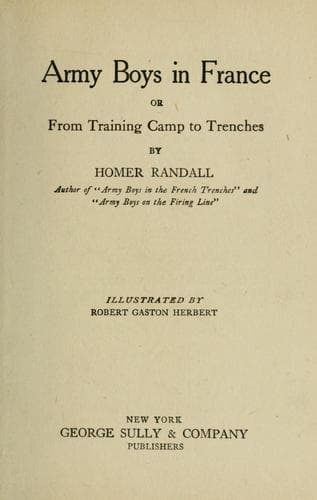
Army Boys in France; or, From Training Camp to TrenchesRandall, Homer
General
Army Boys in France; or, From Training Camp to Trenches
Randall, Homer
World War, 1914-1918 -- France -- Juvenile fiction
Just then the officer of the day approached. Rabig slunk away from the
window while Frank resumed his pacing, and the episode ended then and
there.
At the end of three days Rabig's term expired and he was sent back
again to his place in the ranks, somewhat subdued in manner though
really unchastened in spirit.
His hatred of Frank was unabated and in fact seemed to have taken on
extra bitterness since the sharp exchange at the guard-house. He
seldom passed Frank without a sneer on his lip or an ugly gleam in his
eye, which betrayed the smoldering fires within.
Frank, on his part, bore no rancor. His nature was too open and
healthy to nurse a grudge, and although he avoided speaking to Rabig,
he seldom thought of him except when the exigencies of military duty
threw them together.
"You're as popular as the smallpox with that gink," said Billy one day,
after Rabig had passed them with his usual malignant stare at Frank.
"You want to keep your eyes open, Frank," added Tom, who, knowing Rabig
better than Billy, distrusted him profoundly. "He's got something up
his sleeve."
"I don't think it would be safe to be alongside him in the trenches,"
put in Bart. "Especially on a dark night. It's an easy thing there to
slip a bullet into a man you don't like, and charge it up against the
Germans."
"Oh, shucks!" laughed Frank, "Rabig's pretty bad but he isn't as bad as
that."
Several weeks went by, weeks of strain and hard work that were rapidly
converting the new army into a first-class fighting machine.
But "all work and no play makes Jack a dull boy," and the officers saw
to it that there was plenty of entertainment for the men when the hard
day's work was over.
There were improvised vaudeville entertainments and, as there were many
actors in the ranks, including some whose names were famous, the
performances were really good.
Then too, there were boxing matches, which were perhaps the most
popular of all. The boys themselves took part in these and there was a
good deal of rivalry, all of it good-natured, among the representatives
of the various companies and regiments in camp.
The Government had been quick to recognize the value of boxing, not
only as a physical exercise, but because it aided vastly in the bayonet
drill.
The two contests closely resembled each other and excellence in one
meant excellence in both. There was the same sparring for advantage,
feinting, alternate advance and retreat, evading and covering up,
attacking and defending.
And because of this, every camp had its official boxing instructor and
the sport formed part of the regular drill.
Great care was taken to avoid any brutal element. The rounds were
limited to two minutes each and the men were cautioned against letting
go with all their weight.
It was a matter of points secured by skill, and it was closely akin to
a fencing bout with buttons on the foils to avoid any serious injury.
Public-domain text, read in full here on John Shaqi.
Reviews
Reviews
No reviews yet
Be the first to share your thoughts on this work.
Elsewhere in the archive
Join the Discussion
Join the discussion
Sign in to leave a comment or review.
Sign InorCreate an account