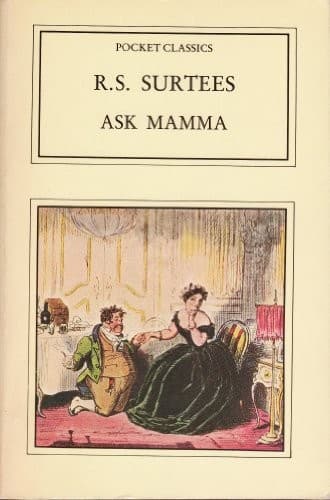
"Ask Mamma"; or, The Richest Commoner In EnglandSurtees, Robert Smith
General
"Ask Mamma"; or, The Richest Commoner In England
Surtees, Robert Smith
England -- Social life and customs -- 19th century -- Fiction; Fox hunting -- Fiction
And each man set to work on the pocket of his neighbour with an
earnestness inspired by the idea of saving his own. The result
was that a very considerable sum was raised for the four days
a-week, which, somehow or other, the country rarely or ever got,
except in the shape of advertisements; for Sir Moses always had
some excuse or other for shirking it,—either his huntsman had got
drunk the day before, or his first whip had had a bad fall, or
his second whip had been summoned to the small debts court, or
his hounds had been fighting and several of them had got lamed,
or the distemper had broken out in his stable, or something or
other had happened to prevent him.
Towards Christmas, or on the eve of an evident frost, he came
valiantly out, and if foiled by a sudden thaw, would indulge in
all sorts of sham draws, and short days, to the great disgust of
those who were not in the secret. Altogether Sir Moses Mainchance
rode Hit-im and Hold-im shire as Hit-im and Hold-im shire had
never been ridden before.
223m
_Original Size_
CHAPTER XXIX. THE PANGBURN PARK ESTATE.
THE first thing that struck Sir Moses Mainchance after he became
a “laird” was that he got very little interest for his money.
Here he was he who had always looked down with scorn upon any
thing that would not pay ten per cent., scarcely netting three by
his acres. He couldn’t understand it—dom’d if he could. How could
people live who had nothing but land? Certainly Mr. Plantagenet
Smith had left the estate in as forlorn a condition as could well
be imagined. Latterly his agent, Mr. Tom Teaser, had directed his
attention solely to the extraction of rent, regardless of
maintenance, to say nothing of improvements, consequently the
farm buildings were dilapidated, and the land impoverished in
every shape and way. Old pasture-field after old pasture-field
had gradually succumbed to the plough, and the last ounce of
freshness being extracted, the fields were left to lay themselves
down to weeds or any thing they liked. As this sort of work never
has but one ending, the time soon arrived when the rent was not
raiseable. Indeed it was the inability to make “both ends meet,”
as Paul Pry used to say, which caused Mr. Plantagenet Smith to
retire from Burke’s landed gentry, which he did to his own
advantage, land being sometimes like family plate, valuable to
sell, but unprofitable to keep.
Public-domain text, read in full here on John Shaqi.
Reviews
Reviews
No reviews yet
Be the first to share your thoughts on this work.
Elsewhere in the archive
Join the Discussion
Join the discussion
Sign in to leave a comment or review.
Sign InorCreate an account