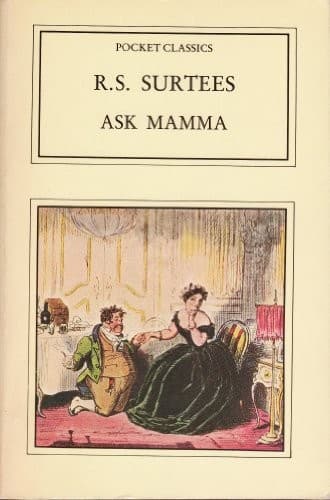
"Ask Mamma"; or, The Richest Commoner In EnglandSurtees, Robert Smith
General
"Ask Mamma"; or, The Richest Commoner In England
Surtees, Robert Smith
England -- Social life and customs -- 19th century -- Fiction; Fox hunting -- Fiction
In these accelerated days, when even the very street waggon
horses trot, they are the only beings whose pace has not been
improved. The small farmer is just the same slowly moving
dawdling creature that he was before the perfection of steam.
Never punctual, never ready, never able to give a direct answer
to a question; a pitchfork at their backs would fail to push some
of these fellows into prosperity. They seem wholly lost to that
emulative spirit which actuates the trader to endeavour to make
each succeeding year leave him better than the last. A farmer
will be forty years on a farm without having benefited himself,
his family, his landlord, or any human being whatever. The last
year’s tenancy will find him as poor as the first, with, in all
probability, his land a great deal poorer. In dealing, a small
farmer is never happy without a haggle. Even if he gets his own
price he reproaches hiself when he returns home with not having
asked a little more, and so got a wrangle. Very often, however,
they outwit themselves entirely by asking so much more than a
thing is really worth, that a man who knows what he is about, and
has no hopes of being able to get the sun to stand still,
declines entering upon an apparently endless negotiation.
See lawyer Hindmarch coming up the High Street at Halterley fair,
leading his great grey colt, with his landlord Sir Moses hailing
him with his usual “Well my man, how d’ye do? I hope you’re well,
how much for the colt?”
The lawyer’s keen intellect—seeing that it is his landlord, with
whom he is well over the left—springs a few pounds upon an
already exorbitant price, and Sir Moses, who can as he says,
measure the horse out to ninepence, turns round on his heel with
a chuck of his chin, as much as to say, “you may go on.” Then the
lawyer relenting says, “w—h—o—y, but there’ll be summit to return
upon that, you know, Sir Moses, Sir.”
“I should think so,” replies the Baronet, walking away, to “Well
my man—how d’ye do? I hope you’re well,” somebody else.
A sale by auction of agricultural stock illustrates our position
still further, and one remarkable feature is that the smaller the
sale the more unpunctual people are. They seldom get begun under
a couple of hours after the advertised time, and then the
dwelling, the coaxing, the wrangling, the “puttings-up” again,
the ponderous attempts at wit are painful and oppressive to any
one accustomed to the easy gliding celerity of town auctioneers.
A conference with a farmer is worse, especially if the party is
indiscreet enough to let the farmer come to him instead of his
going to the farmer.
Public-domain text, read in full here on John Shaqi.
Reviews
Reviews
No reviews yet
Be the first to share your thoughts on this work.
Elsewhere in the archive
Join the Discussion
Join the discussion
Sign in to leave a comment or review.
Sign InorCreate an account